

What Does Manhattan Hotel District Mean for Travelers?
Disclosure: This post may contain affiliate links. We may earn a commission for purchases made through links in this post, at no cost to you.
The Manhattan hotel district is not an official geographic boundary but a practical term describing the major hotel concentration zones across Manhattan that travelers use to plan their NYC stays. No single official zone exists on any city map. Instead, the term covers several distinct neighborhoods, each with its own vibe, price point, and traveler appeal. Midtown Manhattan functions as the default hub for most first-time visitors, thanks to its dense transit access and proximity to landmarks like Central Park, the Empire State Building, and Times Square. Understanding what each Manhattan hotel zone actually offers saves you from booking the wrong neighborhood for your trip.
What does the Manhattan hotel district mean in practice?
The Manhattan hotel district, as travelers use the phrase, refers to four main neighborhood clusters where hotels concentrate: Midtown West (Times Square), Midtown East, Midtown South (Bryant Park), and Lower Manhattan. Each cluster functions as its own mini market with different pricing, atmospheres, and traveler profiles. This is the standard industry framing used by hospitality analysts and travel planners alike, so you will see these submarkets referenced across booking platforms and travel guides.
Midtown West and Times Square sit at the center of the tourist experience. Step outside almost any hotel here and you get a full sensory overload experience: neon signs, crowds, street performers, and the smell of roasted nuts from corner carts. Midtown West averages $260 to $380 per night as of Q2 2026, making it one of the pricier options despite the noise and congestion.

Midtown South, anchored by the Bryant Park corridor running roughly from 40th to 42nd Streets between Fifth and Seventh Avenues, offers a noticeably calmer hotel base compared to Times Square. Business travelers and repeat visitors tend to favor this zone. You are still close to Midtown attractions but without the tourist chaos right outside your door.
Lower Manhattan has transformed significantly over the past decade. Once considered purely a financial district, it now attracts both business travelers and leisure visitors. Lower Manhattan commands $290 to $400+ per night as of Q2 2026, reflecting its premium positioning and the area’s growth as a destination in its own right.
| Hotel district | Average nightly rate (Q2 2026) | Best for |
|---|---|---|
| Midtown West / Times Square | $260–$380 | First-time visitors, Broadway, nightlife |
| Midtown South / Bryant Park | $220–$320 | Business travelers, quieter stays |
| Midtown East | $240–$360 | Corporate travel, upscale dining |
| Lower Manhattan | $290–$400+ | Business, premium leisure, history |
| Brooklyn / Long Island City | $150–$180 | Budget travelers, local vibe |
How your trip purpose should drive your district choice
Hotel district selection depends heavily on trip intent, whether that is business, leisure, nightlife, or a mix. Getting this match right is the single biggest factor in whether you feel your hotel was worth the money.
Here is how to align your trip goals with the right Manhattan hotel area:
- Broadway and nightlife. Choose Midtown West. You want to be within walking distance of the Theater District, and the energy of the neighborhood matches the reason you came. Hotels on 44th to 46th Streets between 8th and 9th Avenues give you Theater District access without the worst of the Times Square noise.
- Business travel. Lower Manhattan or Midtown East works best. Both zones are built around corporate demand, with easy access to financial institutions, law firms, and conference venues. Lower Manhattan recorded a RevPAR growth of 9.6% year over year in Q2 2024, reflecting how seriously the area has grown as a business destination.
- Quiet, comfortable base for sightseeing. Bryant Park and Midtown South give you the best of both worlds. You are close enough to Midtown landmarks to walk to many of them, but the neighborhood itself is manageable and far less chaotic.
- Budget travel. Brooklyn and Long Island City are the smart play. Brooklyn hotels run 40 to 50% cheaper than Manhattan equivalents, typically $150 to $180 per night, with subway commutes of 20 to 35 minutes into Midtown. That price gap adds up fast over a multi-night stay.
- Families with kids. Midtown West keeps everything accessible. Central Park, the Museum of Natural History, and the Theater District are all reachable without complicated transit planning.
Pro Tip: Good subway connectivity usually matters more than a prestigious neighborhood label. A hotel two blocks from a major subway station in Midtown South will serve you better than a flashier address that requires a cab to get anywhere.
What pricing trends and availability patterns should you expect?
Manhattan hotel pricing is not static. It shifts based on business demand, seasonal events, and how far in advance you book. Knowing these patterns helps you avoid overpaying.
A few key pricing realities to keep in mind:
- Weekday vs. weekend swings. Midtown East and Lower Manhattan see weekend rate dips because corporate travelers leave on Fridays. If you are visiting for leisure, booking a Midtown East hotel for a Friday to Sunday stay can get you a premium address at a lower price.
- Times Square stays consistently expensive. Unlike other districts, Times Square does not dip much on weekends because tourist demand fills the gap left by business travelers. You pay a premium all week long.
- Book about four weeks out. Booking roughly 4 weeks in advance secures the best rates in high-demand zones. Last-minute bookings in Manhattan regularly carry price premiums and limited room selection, especially around major events like the New York City Marathon in November.
- Hotel supply is tighter than it used to be. 2021 zoning regulations eliminated as-of-right hotel development in Manhattan, which slowed new inventory growth. Fewer new hotels entering the market means less competition to drive prices down, so quality and value vary more widely across existing properties.
“The best-value Manhattan hotel is rarely the one with the flashiest location. It is the one that puts you on a subway line that connects to everything you actually want to do.”
For a deeper look at how rates shift across the calendar, Powersearch has a useful breakdown of NYC rate fluctuation patterns that can help you time your booking.
How to balance convenience, ambiance, and budget
Choosing a Manhattan hotel district is really a trade-off exercise. You are weighing noise against convenience, price against location, and atmosphere against practicality. Here is how the main zones compare across those dimensions:
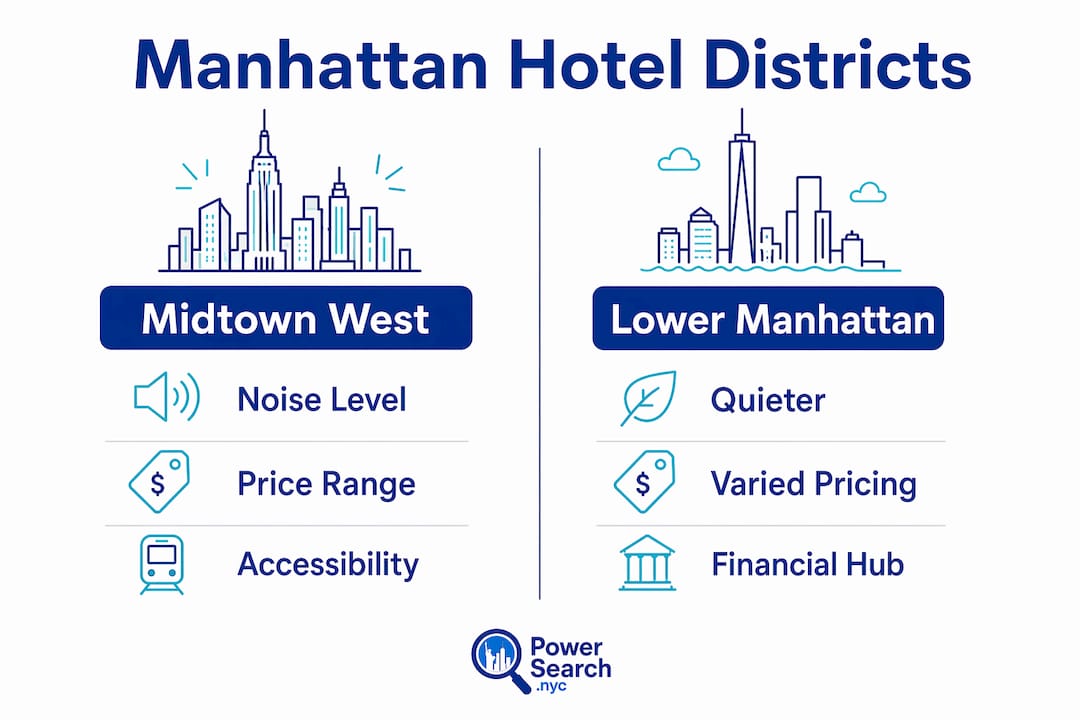
| Factor | Times Square | Bryant Park | Lower Manhattan | Brooklyn |
|---|---|---|---|---|
| Noise level | High | Low to moderate | Low | Low |
| Tourist crowds | Very high | Moderate | Low to moderate | Low |
| Transit access | Excellent | Excellent | Good | Good |
| Avg. nightly rate | $260–$380 | $220–$320 | $290–$400+ | $150–$180 |
| Best for | First-timers, families | Business, repeat visitors | Business, premium leisure | Budget travelers |
First-time visitors almost always gravitate toward Times Square, and honestly, spending at least one night in that zone is worth it for the experience. You will step outside and immediately feel like you are in a movie. But for stays longer than two nights, the noise and crowds wear on most people. Repeat visitors and anyone prioritizing sleep quality tend to migrate toward Bryant Park or Midtown East.
Budget travelers who are comfortable on the subway should seriously consider affordable Manhattan hotel deals or Brooklyn options. The savings are real, and the commute is genuinely manageable.
Pro Tip: If you want Times Square proximity without the noise, look at hotels on side streets in the Theater District, specifically 44th to 46th Streets between 8th and 9th Avenues. You get the location without the full chaos of being directly on the square.
For a broader breakdown of which Manhattan neighborhoods suit different traveler types, the Powersearch guide to best Manhattan areas for leisure travelers is worth reading before you book.
Key takeaways
Manhattan hotel districts are informal neighborhood clusters, not official zones, and matching your district to your trip purpose is the most reliable way to get good value.
| Point | Details |
|---|---|
| No official district exists | The Manhattan hotel district is a practical term for key hotel neighborhoods, not a mapped boundary. |
| Midtown West is the default hub | Times Square and Midtown West average $260 to $380 per night and suit first-time visitors best. |
| Bryant Park offers a quieter alternative | Midtown South runs calmer and cheaper, making it ideal for business travelers and repeat visitors. |
| Book four weeks ahead | Advance booking secures better rates and availability, especially during peak events like the NYC Marathon. |
| Brooklyn cuts costs significantly | Brooklyn hotels cost 40 to 50% less than Manhattan, with a 20 to 35 minute subway commute. |
Why I think the “hotel district” label can mislead you
Here is something most NYC travel guides skip over: the phrase “Manhattan hotel district” can actually work against you if you take it too literally. When I first started helping people plan NYC trips, I noticed a pattern. Travelers would fixate on being in the hotel district, which usually meant Times Square, and end up paying top dollar for a room they barely slept in because the street noise was relentless.
The smarter move is to think in terms of subway lines, not neighborhood prestige. Midtown South is my personal go-to recommendation for most travelers. You are on the 1, 2, 3, A, C, and E lines, Bryant Park is a five-minute walk, and the area feels like a real neighborhood rather than a tourist corridor. You will see locals walking their dogs in the morning, not just other visitors hauling luggage.
My honest advice for first-timers: spend one night near Times Square if the experience matters to you, then move to a quieter district for the rest of your stay. The contrast alone teaches you more about Manhattan hotel zones than any guide can. And if your budget is tight, do not feel pressured to stay in Manhattan at all. Brooklyn is genuinely great, and the subway makes the distance irrelevant for most itineraries. The goal is a trip that works for you, not a hotel address that sounds impressive back home.
— Mark
Find your perfect Manhattan hotel with Powersearch
Planning a NYC trip is a lot easier when you can search hotels by neighborhood, price tier, and availability all in one place.
Powersearch lets you filter Manhattan hotels by district, from Times Square to Lower Manhattan to Bryant Park, so you can compare options side by side without jumping between a dozen booking sites. You can also browse deals for 2026 travel dates and check proximity to the attractions and transit lines that matter most to your trip. Whether you are after a budget-friendly room in Brooklyn or a premium stay in Lower Manhattan, start your NYC hotel search on Powersearch and find the right fit for your itinerary. You can also explore the full NYC travel planning hub for neighborhood guides, attraction tips, and booking advice.
FAQ
What is the Manhattan hotel district?
The Manhattan hotel district is an informal term for the major hotel concentration zones in Manhattan, including Midtown West, Midtown South, Midtown East, and Lower Manhattan. No official boundary defines it; travelers and hospitality professionals use it to describe where most NYC hotels cluster.
Which Manhattan hotel zone is best for first-time visitors?
Midtown West and Times Square are the most popular choice for first-time visitors due to walkable access to Central Park, Broadway, and major landmarks. Rates average $260 to $380 per night as of Q2 2026.
Is it cheaper to stay outside the Manhattan hotel area?
Brooklyn and Long Island City hotels run 40 to 50% cheaper than Manhattan equivalents, typically $150 to $180 per night, with subway commutes of 20 to 35 minutes into Midtown. For budget-conscious travelers, the savings are significant.
When should I book a Manhattan hotel to get the best rate?
Booking roughly four weeks in advance secures the best rates and availability in high-demand Manhattan hotel zones. Last-minute bookings carry price premiums, particularly around major events like the New York City Marathon in November.
Why is Bryant Park considered a quieter Manhattan hotel zone?
The Bryant Park corridor, running from roughly 40th to 42nd Streets between Fifth and Seventh Avenues, sits away from the heaviest tourist foot traffic while still offering excellent Midtown access. It is consistently rated as one of the calmer hotel bases in central Manhattan.
No Comments