

NYC Commission-Based Booking Platforms: A Pro Guide
Disclosure: This post may contain affiliate links. We may earn a commission for purchases made through links in this post, at no cost to you.
NYC commission-based booking platforms are specialized software tools that automate the full cycle of hotel bookings and commission payouts, from the moment a reservation lands to the moment funds settle. For hospitality professionals in New York City, that automation is the difference between chasing spreadsheets at midnight and having a clean dashboard ready before the morning briefing. Platforms like GroupPay and Onyx CenterSource have become go-to solutions for NYC hotels that need integrated commission tracking, real-time booking sync, and tight connections to existing property management systems (PMS). Here is what these platforms actually do:
- Automate commission calculations and payouts across multiple booking channels
- Sync reservation data in real time with your PMS and channel manager
- Generate reporting dashboards that show commission liability at a glance
- Flag discrepancies between booked and paid commissions before they become disputes
- Integrate with travel agent networks, OTAs, and direct booking engines simultaneously
Understanding how to pick and use the right platform can genuinely move the needle on your bottom line, especially in a market as competitive and fast-moving as New York City.
How commission management automation works for NYC hotels
Manual commission reconciliation is slow, error-prone, and expensive. A single missed payout or miscalculated rate can trigger a dispute that takes weeks to resolve, and in a city where hotel occupancy swings hard by season, those errors pile up fast.

Automation changes that equation. Commission tracking tools sync booking data directly into your PMS, calculate the correct commission rate for each channel, and queue payouts without manual intervention. Reporting dashboards give revenue managers a live view of what is owed, what has been paid, and where gaps exist. Alerts fire when a booking channel’s payout falls outside the expected range, catching problems before they compound.
Key advantages NYC hotels see from commission automation:
- Fewer billing disputes with travel agents and OTAs
- Faster month-end close because reconciliation runs continuously, not in batches
- Cleaner audit trails for finance and compliance teams
- Real-time visibility into net revenue after commissions across all channels
- Reduced reliance on manual data entry, which cuts labor costs
Pro Tip: Set up automated alerts for any commission variance above a fixed dollar threshold. Even a $50 discrepancy caught early is easier to resolve than a $5,000 dispute caught at quarter-end.
What NYC hospitality venues are actually using
The New York market has a wider range of booking platform needs than most cities. You have got full-service hotels managing travel agent commissions through platforms like Onyx CenterSource, which handles commission billing and reconciliation at scale. You have got group-focused properties using GroupPay to automate billing across multi-room blocks. And then you have got a whole layer of niche platforms built specifically for NYC’s event and dining scene.

Rendezvous is a good example of that niche layer. It focuses entirely on NYC birthday venue bookings, connecting guests with bars and restaurants through instant confirmation and transparent pricing. No back-and-forth emails, no surprise minimums. ResX takes a different angle, tackling the very NYC problem of restaurant reservation hoarding by enabling reservation swaps between diners at the last minute.
For hotel-specific needs, the core platform features to look for include:
- Two-way PMS integration that prevents double-bookings
- Channel manager connectivity across OTAs, GDS, and direct booking engines
- Commission rate configuration by channel and booking type
- Instant booking confirmation delivery to guests and agents
- Detailed commission reporting exportable to accounting systems
The NYC accommodation landscape for groups adds another layer of complexity, since group blocks often involve negotiated commission rates that differ from standard OTA terms.
Why NYC hospitality professionals actually benefit from these platforms
The core financial case is straightforward. OTAs charge 15–30% per booking, and every percentage point you pay out is margin you do not keep. Commission-based platforms that automate tracking and reconciliation help you capture every dollar you are owed while giving you the data to make smarter channel decisions over time.
Beyond the numbers, owning the guest relationship matters. Direct booking channels let you control pricing, policies, and communication from the first touchpoint, which is how repeat business actually gets built. A guest who books through an OTA is the OTA’s customer. A guest who books direct is yours.
Common benefits NYC hospitality professionals report:
- Higher net revenue per booking by reducing OTA dependency
- Full commission transparency across all channels in one dashboard
- Faster dispute resolution with automated audit trails
- Better guest data ownership, enabling targeted follow-up and loyalty programs
- Compliance-ready reporting for finance and legal teams
Security and data compliance are real considerations too, particularly for NYC properties handling payment card data across multiple booking channels. Platforms that are PCI-DSS compliant and offer role-based access controls reduce your exposure considerably.
NYC’s booking niches and the direct booking alternative
Here is something worth knowing: not every commission-based platform is the right fit for every NYC property. The choice between a commission-based OTA, a managed commission platform like Onyx CenterSource, and a direct booking engine is really a question of what you are optimizing for.
OTA commissions of 15–30% are the price of visibility on high-traffic channels. That trade-off makes sense when you need to fill rooms fast or reach travelers who have never heard of your property. But once a guest has stayed with you, paying that commission again on their return visit is pure margin loss.
Direct booking engines solve that problem. A frictionless embedded booking engine on your hotel’s website keeps guests on your site from search through checkout, eliminating the redirect that kills conversions. Hotels keep 100% of their revenue on direct bookings, avoiding the commission cuts that OTAs apply.
The subscription versus commission fee model is worth understanding clearly. Flat monthly fee platforms charge a fixed amount regardless of booking volume, so a record month costs the same as a slow one. Commission platforms, by contrast, take a percentage of every booking, which means your costs scale with your success. For high-volume NYC properties, that distinction can add up to tens of thousands of dollars annually.
NYC-specific platforms like ResX and Rendezvous sit in a different category entirely. They address problems that general OTAs simply do not touch, like last-minute reservation swaps or instant birthday venue confirmations. Combining a direct booking engine for returning guests with a niche platform for event-driven demand is a strategy that fits NYC’s chaotic, high-velocity hospitality market well.
Pro Tip: Use a NYC hotel commission rates guide to benchmark your current OTA costs against what a direct booking engine would cost you annually. The math often surprises people.
- Evaluate commission costs channel by channel, not as a blended average
- Prioritize direct booking for repeat guests; use OTAs for new customer acquisition
- Consider niche platforms for event-driven demand that OTAs underserve
- Match your fee model (flat vs. commission) to your booking volume and seasonality
How do the top NYC-specific platforms compare on features and fees?
Picking the right platform comes down to what your property actually needs. Here is a practical comparison of the main platform types serving NYC hotels and hospitality venues:
| Platform Type | Best For | Fee Model | Key Feature |
|---|---|---|---|
| GroupPay | Group block billing | Commission-based | Automated group commission billing |
| Onyx CenterSource | Travel agent commission management | Commission-based | Integrated reconciliation at scale |
| Direct booking engine | Returning guests, margin protection | Flat or free | 100% revenue retention (no commission), PMS integration |
| Flat-fee platforms (e.g., Theybook) | High-volume venues | Flat monthly fee | Cost predictability, zero per-booking cut |
| Niche NYC platforms (ResX, Rendezvous) | Restaurant and event bookings | Varies | NYC-specific use cases, instant confirmation |
For hotels focused on managing room rate fluctuation across seasons, a platform with dynamic pricing integration and real-time PMS sync is worth prioritizing over one with a lower headline fee but weaker connectivity.
The hospitality imaging tools available for NYC venues can also complement your booking platform by improving the visual quality of your listings, which directly affects conversion rates on both OTA and direct channels.
Common challenges with commission platforms and how to fix them
Even well-chosen platforms create friction if you are not set up correctly. These are the problems NYC hotel teams run into most often, and what actually fixes them.
PMS integration failures. When your booking platform and PMS are not talking to each other in real time, you get double-bookings, missed commissions, and reconciliation nightmares. The fix is insisting on certified, two-way integration before you sign any contract. Ask the vendor for a list of PMS systems they have live integrations with, not just “compatible with.”
Commission rate mismatches. Different channels have different negotiated rates, and platforms that do not support channel-level rate configuration will apply a blended rate that is wrong for almost every booking. Configure rates by channel from day one and audit them quarterly.
Slow dispute resolution. Commission disputes with OTAs and travel agents drag on when you lack documentation. Platforms with automated audit trails and timestamped booking records cut resolution time significantly. If your current platform cannot produce a clean dispute report in under five minutes, that is a gap worth addressing.
Onboarding complexity. NYC hotels often run multiple booking channels simultaneously, and migrating to a new commission platform mid-season is genuinely risky. Plan any platform switch for a low-occupancy period, and run parallel systems for at least 30 days before cutting over fully.
Data security gaps. Handling payment card data across multiple channels creates compliance exposure. Verify that any platform you use is PCI-DSS compliant and supports role-based access so that front desk staff cannot access financial reconciliation data they do not need.
What NYC hotels and hospitality professionals say about these platforms
The feedback from NYC hospitality teams on commission management platforms tends to cluster around a few consistent themes. Properties that moved from manual reconciliation to automated platforms consistently report faster month-end close and fewer disputes with travel agents. The time savings alone often justify the platform cost within the first quarter.
GroupPay users in the group sales segment note that automated billing across multi-room blocks removes a category of error that used to require a dedicated staff member to manage. Onyx CenterSource is frequently cited by revenue managers at larger NYC hotels for its depth of reporting and its established relationships with travel agent networks, which simplifies the reconciliation process on both sides.
Niche platform users tell a different story. Venues using Rendezvous for birthday party bookings report that instant confirmation and upfront pricing reduce the volume of inquiries that never convert, because guests self-select based on real pricing rather than estimated minimums. ResX users in the restaurant space describe the reservation swap model as a practical fix for a very NYC problem: a table that would otherwise go empty at a hot spot gets filled by someone who actually wants it.
The common thread across all of these experiences is that the right platform for your property depends on your specific booking mix, your channel strategy, and how much administrative capacity you have. There is no single best platform for all of NYC hospitality. There is only the right fit for your operation.
Powersearch helps you find the right NYC hotel for every booking need
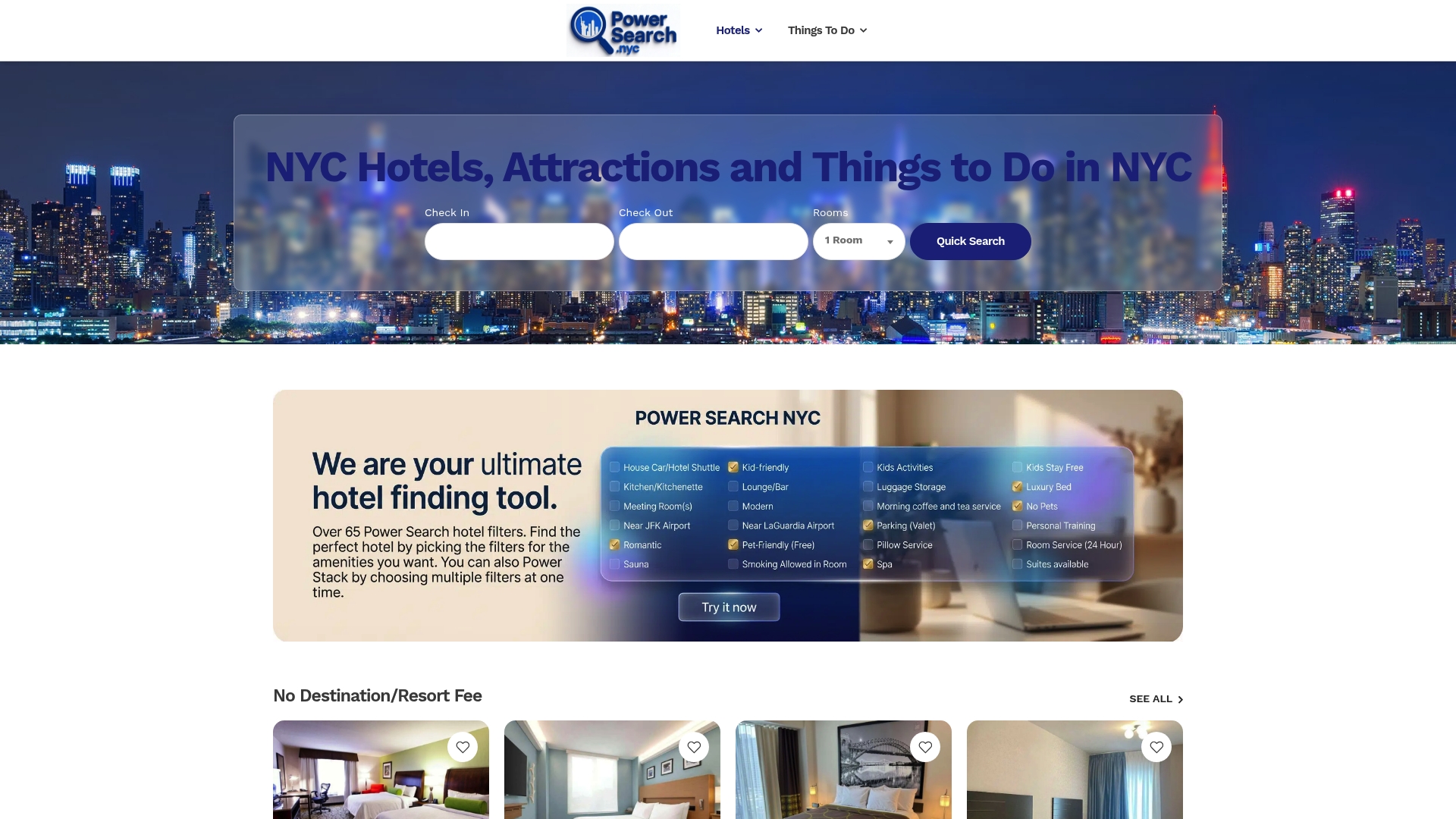
Powersearch is built for travelers who want to cut through the noise and find the right NYC hotel without wading through hidden fees or confusing commission structures. While the platforms covered in this article serve the hotel side of the equation, Powersearch serves the traveler side, giving you a transparent, curated search experience across NYC’s full range of accommodations, from family-friendly hotel suites to boutique properties in neighborhoods you might not have considered.
The site aggregates real listings, highlights fee structures, and helps you compare options by neighborhood, amenity, and price point without the markup that traditional booking channels add. If you are a hospitality professional looking to understand how travelers are finding and evaluating NYC hotels, Powersearch gives you a direct window into that decision-making process. Start your search at Powersearch NYC and see how travelers are choosing hotels in your market right now.
Key Takeaways
NYC commission-based booking platforms deliver the most value when they combine automated reconciliation, real-time PMS integration, and channel-level commission rate configuration tailored to the city’s high-velocity hospitality market.
| Point | Details |
|---|---|
| OTA commission cost | OTAs charge 15–30% per booking, making commission automation and direct booking a financial priority. |
| Automation advantage | Automated platforms reduce manual errors, speed up month-end close, and generate audit trails that simplify dispute resolution. |
| NYC niche platforms | ResX and Rendezvous address NYC-specific problems like reservation hoarding and instant event venue confirmation that general OTAs do not solve. |
| Fee model choice | Flat monthly fee platforms offer cost predictability; commission-based models scale costs with booking volume, which matters for high-volume NYC properties. |
| Powersearch for travelers | Powersearch gives travelers a transparent, curated way to find and compare NYC hotels, offering hospitality professionals insight into how guests make booking decisions. |
No Comments