
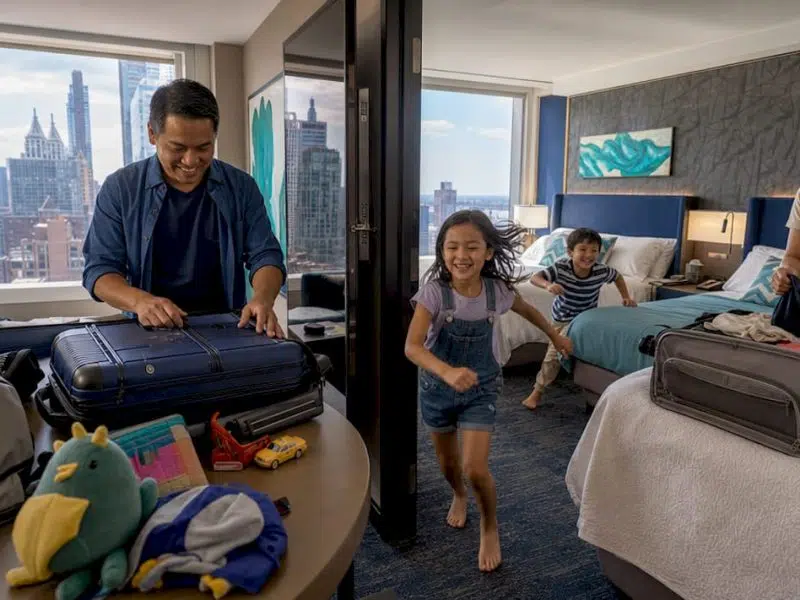
What Does Connecting Rooms Hotel Mean for Families?
Disclosure: This post may contain affiliate links. We may earn a commission for purchases made through links in this post, at no cost to you.
Connecting rooms in a hotel are two adjacent guest rooms joined by a private interior door, letting guests move between rooms without stepping into the hallway. This setup is the industry’s standard answer to a very specific travel problem: how do you keep a family or group together while still giving everyone their own space? Connecting rooms are popular among families, friend groups, and multi-generational travelers who want proximity without sacrificing privacy. If you’ve ever tried to book a hotel for six people and wondered whether you’d all end up on different floors, connecting rooms are exactly what you’re looking for.
What does connecting rooms hotel mean, exactly?
Connecting rooms, also called communicating rooms or interconnecting rooms, are defined by one feature above all others: the internal door. That door sits between two rooms and, when unlocked from both sides, creates a private passage. You don’t need to go into the hallway, knock on a neighbor’s door, or coordinate meeting times in the lobby. You just open the door and walk through.
The terminology can get confusing fast. Hotels use the terms “communicating,” “interconnecting,” and “connecting” interchangeably, but the core feature is always the same: an internal door that provides private access between rooms. What matters when you’re booking is not the label the hotel uses. What matters is whether there is a lockable interior door between the two rooms.
When that door is locked, each room functions completely independently. Guests on one side have no access to the other. This is what makes connecting rooms so flexible. You get the feel of a larger shared space when you want it, and total separation when you don’t.
How connecting rooms differ from adjoining rooms and other room types
This is where most travelers get tripped up, and it’s worth getting right before you book.
Adjoining rooms share a wall but do not have an internal connecting door. Guests in adjoining rooms are next to each other, but they still use the public hallway to visit one another. Adjoining rooms provide proximity without private internal access. That distinction matters enormously if you’re traveling with young children or elderly family members who need easy, private access between rooms at any hour.
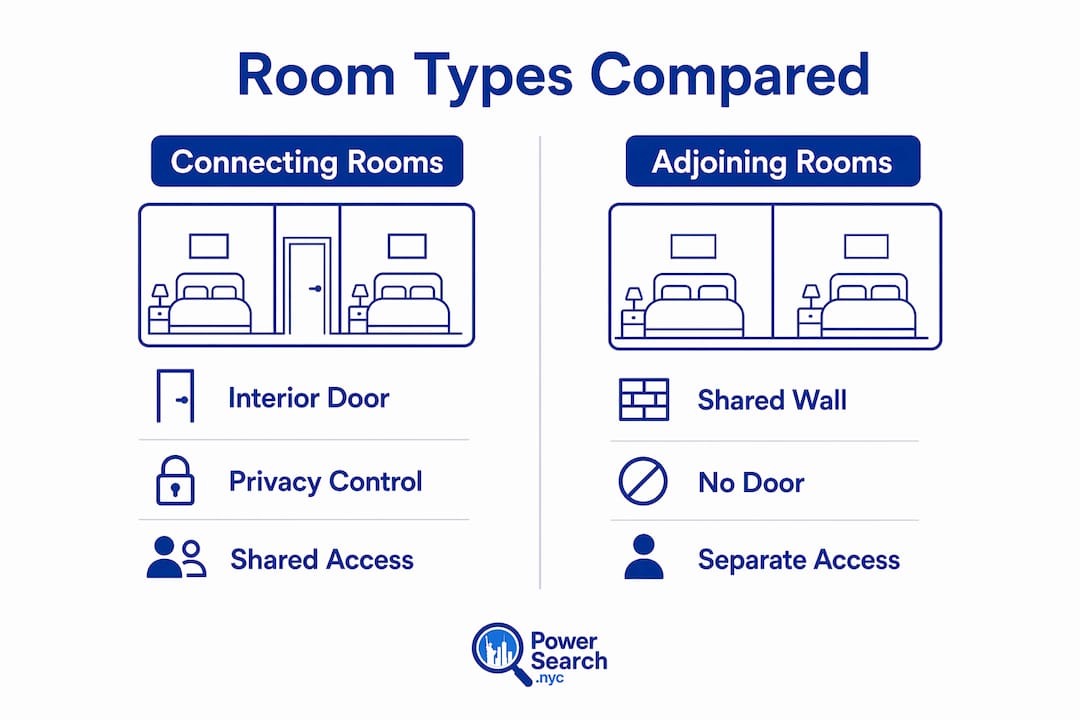
Here’s a quick comparison to make the differences clear:
| Room type | Internal door? | Hallway required? | Best for |
|---|---|---|---|
| Connecting rooms | Yes | No | Families, groups needing private access |
| Adjoining rooms | No | Yes | Travelers who want proximity only |
| Suite with parlor | Shared space | No | Single-party luxury travel |
| Standard rooms | No | Yes | Independent travelers |
A few other things worth knowing:
- The terms “communicating rooms” and “interconnecting rooms” almost always mean connecting rooms with an interior door.
- “Adjoining” does not mean “connecting.” Confirm with the hotel which type you’re getting.
- Some hotels use “adjoining” loosely to mean any rooms near each other, which adds to the confusion.
- Always ask specifically: “Do the rooms have a lockable interior door between them?”
Getting this right before you arrive saves a lot of frustration at the front desk.
Why families and groups love staying in connecting hotel rooms
The advantages of connecting rooms go beyond simple convenience. The primary benefit is privacy combined with togetherness. You get separate sleeping spaces, separate bathrooms, and separate TVs, but you can pop through the interior door any time you want. For a family with a toddler and a teenager, that setup is genuinely life-changing on a trip.
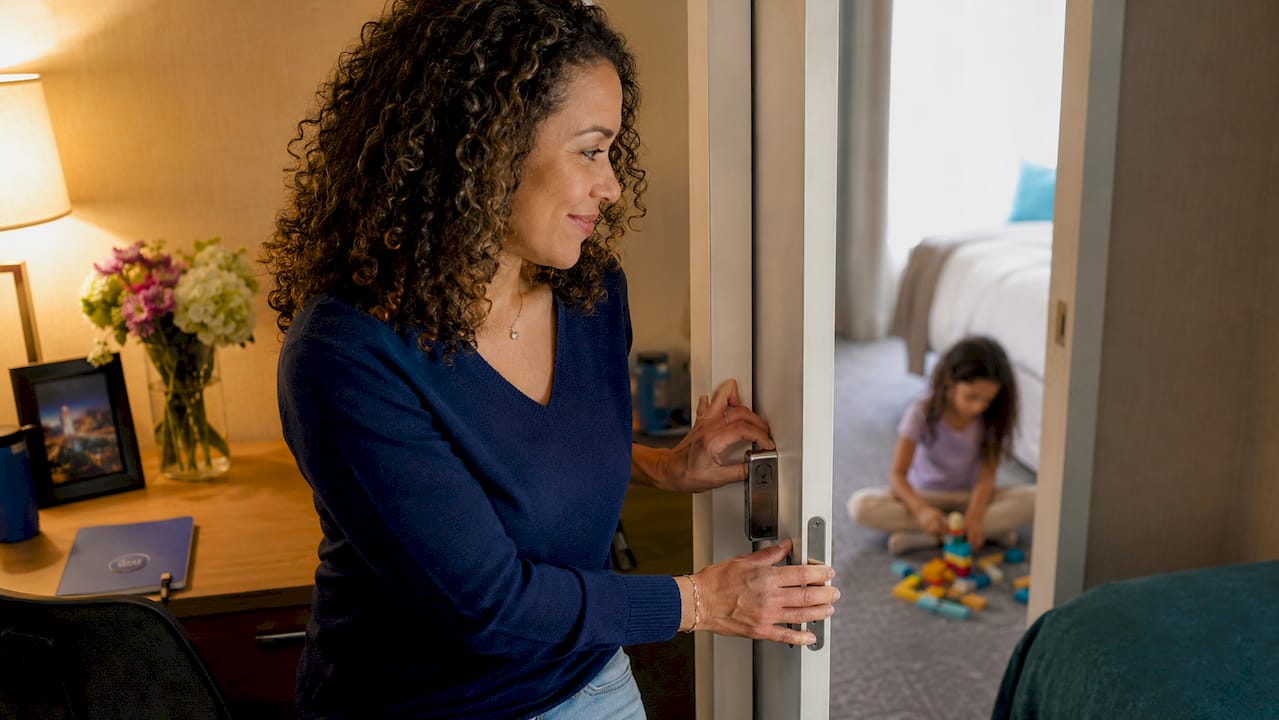
Multiple bathrooms reduce morning congestion for families, which anyone who has shared one bathroom with four people on a travel day will immediately appreciate. Beyond that, connecting rooms give parents the ability to put kids to bed in one room while adults stay up in the other without disturbing anyone.
Here’s who benefits most from this setup:
- Families with young children who need to hear their kids at night but also want adult space in the evening
- Multi-generational groups like grandparents traveling with adult children and grandkids, where organizing multi-generational trips becomes far easier with private internal access
- Friend groups splitting costs but wanting their own sleeping space and bathroom
- Business travelers sharing a trip with a colleague who need separate workspaces and sleep schedules
Guests can control interaction between rooms by locking the interior door, which means the privacy is real, not just theoretical. You’re not stuck with an open-plan arrangement. You choose when to connect and when to separate.
Pro Tip: Book connecting rooms as a single reservation when possible. Hotels are more likely to assign connected rooms from the same block when the booking is unified under one name, rather than two separate reservations that staff have to manually link.
How to request and secure connecting rooms when booking
Knowing what connecting rooms are is only half the battle. Getting them assigned to your group takes a bit of strategy.
-
Book early and request at the time of reservation. Connecting rooms are a fixed part of a hotel’s physical layout. Hotel construction limits how many connecting room pairs exist in any building, so inventory is genuinely limited. The earlier you request, the better your odds.
-
Use the hotel’s website or call directly. Mobile apps like Marriott Bonvoy don’t currently support submitting connecting room requests. You need to use the hotel’s website booking form or call the front desk directly to make the request.
-
State your request in writing. When booking online, use the special requests field to write clearly: “Requesting two connecting rooms with an interior door.” Vague requests get vague results.
-
Follow up after booking. Call the hotel two to three days before arrival to confirm the request is noted. Front desk staff can flag your reservation so the room assignment team knows to prioritize it.
-
Understand that it’s never guaranteed. Connecting room availability depends on real-time hotel inventory at check-in. Even if you requested it months ago, another guest’s extended stay or a maintenance issue could affect your assignment. Have a backup plan.
-
Check in together if rooms are under different names. Guests booking under different names often must be physically present at check-in to authorize activation of the connecting door. This is a security protocol, not a bureaucratic hurdle. Plan accordingly.
Pro Tip: After you’ve booked, call the hotel directly and ask to speak with the front desk manager. Politely explain your travel situation, especially if you’re traveling with young children or elderly family members. Managers have more flexibility to make room assignments work than the standard reservations team.
You can also find NYC hotels with connecting rooms listed and filtered by family-friendly features on Powersearch, which saves you the legwork of calling a dozen hotels individually.
Common challenges and misconceptions about connecting hotel rooms
Even well-prepared travelers run into surprises with connecting rooms. Here’s what to watch for.
The biggest misconception is that requesting a connecting room is the same as guaranteeing one. It isn’t. Hotels note the request, but assignment happens at check-in based on what’s actually available that day. A sold-out weekend, a guest who extended their stay, or a room taken out of service for maintenance can all affect your assignment.
A few other things that catch travelers off guard:
- Terminology errors at booking. If you ask for “adjoining rooms” when you mean “connecting rooms,” you may arrive to find two rooms that share a wall and nothing else. Always use the phrase “interior connecting door” to be precise.
- Security protocols at the door. The connecting door is typically locked from both sides independently. Hotel staff activate access during check-in, but only when both parties are present. If one person checks in hours before the other, the door may not be activated yet.
- Architectural limits. Not every floor or room category has connecting options. If you’ve booked a specific room type like a suite or a corner room, there may simply be no connecting room adjacent to it.
- Assuming all hotels offer them. Boutique hotels and smaller properties often have no connecting rooms at all. This is worth confirming before you book, not after.
Connecting rooms are not a standard amenity at every hotel. They are a specific architectural feature that exists in limited supply. Treat the request like a special accommodation, communicate clearly, and follow up directly with the hotel staff.
For tips on managing the check-in process itself, Powersearch has a practical guide on early check-in strategies that applies directly to connecting room situations.
Key takeaways
Connecting rooms are defined by one feature: a private interior door between two adjacent hotel rooms that guests control from both sides.
| Point | Details |
|---|---|
| Core definition | Connecting rooms have a lockable interior door; adjoining rooms do not. |
| Terminology matters | “Communicating” and “interconnecting” mean connecting rooms; “adjoining” does not. |
| Book early and call | Request connecting rooms at booking and follow up directly with the hotel before arrival. |
| No guarantee at booking | Availability is confirmed at check-in based on real-time inventory, not at reservation. |
| Security at check-in | Both parties must check in together to activate the connecting door when rooms are under different names. |
My honest take on connecting rooms after years of travel planning
I’ve watched a lot of families book hotels thinking they’ve sorted the connecting room situation, only to arrive and find out they’re on different floors entirely. The gap between “we requested it” and “we got it” is real, and it catches people off guard more than almost any other hotel booking issue.
What I’ve found actually works is treating the connecting room request like a conversation, not a checkbox. Call the hotel. Explain your situation. Tell them you have a three-year-old or that grandma needs to be close to the rest of the family. Hotel staff respond to context. A note in a reservation system is easy to overlook. A real conversation with a front desk manager is much harder to ignore.
I’d also push back on the idea that connecting rooms are only for large families. Two friends splitting a room to save money, a couple who wants separate sleeping and working spaces, a caregiver traveling with someone who needs assistance. These are all legitimate use cases that people don’t always think of when they hear “connecting rooms.”
The balance of privacy and connection these rooms provide is genuinely underrated. You’re not crammed into one space, but you’re not isolated either. For NYC trips especially, where the city itself is loud and chaotic, having a calm, organized hotel setup makes the whole experience better. Don’t overlook it.
— Mark
Find NYC hotels with connecting rooms on Powersearch
Planning a family trip to New York City and need connecting rooms? Powersearch makes it straightforward. You can search and filter NYC hotel listings by room configuration, neighborhood, and amenities, so you’re not scrolling through hundreds of options that don’t fit your group’s needs.
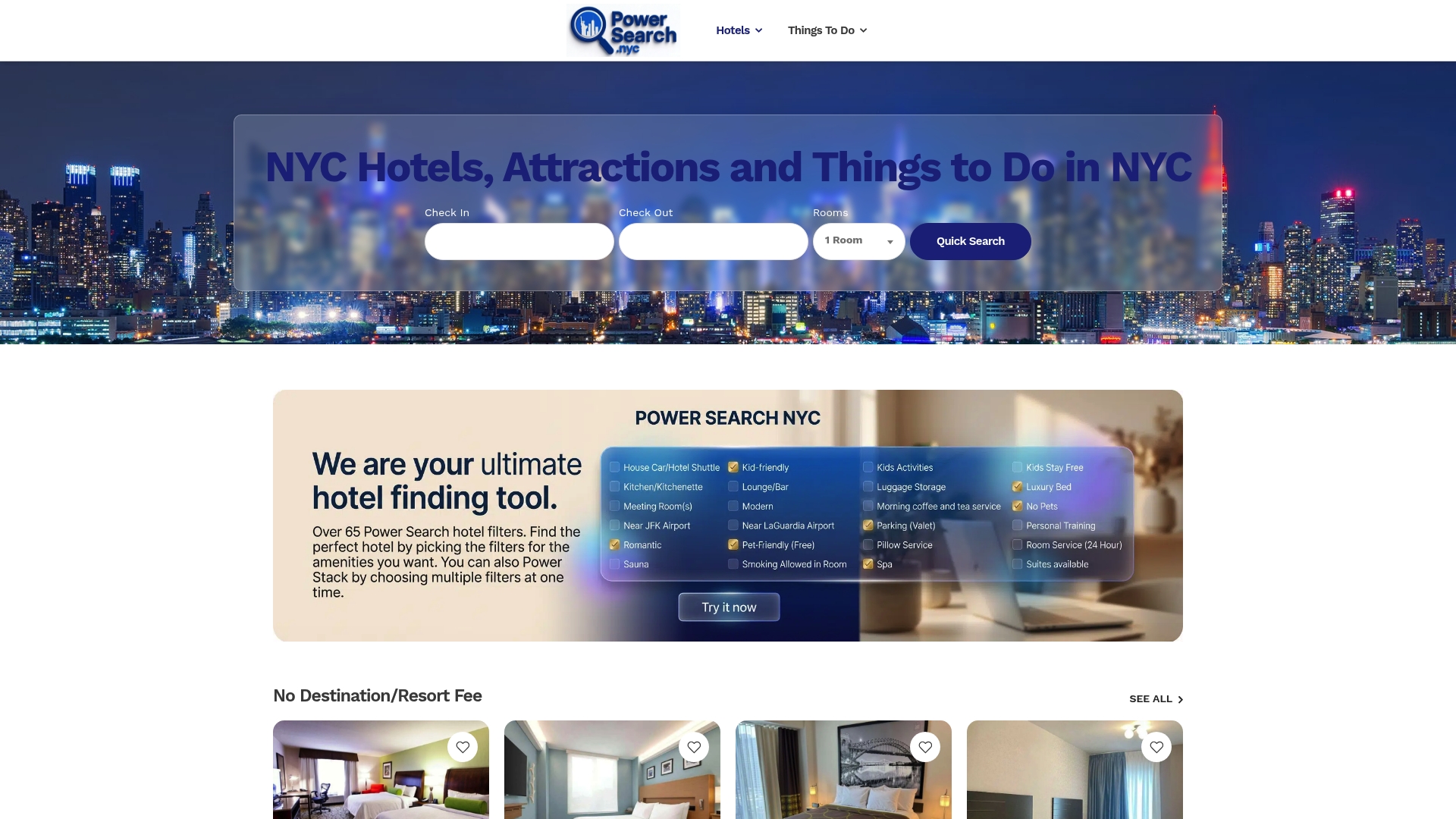
Whether you’re bringing the whole family to see the city for the first time or organizing a group trip with friends, Powersearch gives you the filters and the information to book with confidence. The platform also covers things to do across NYC so you can plan your stay and your itinerary in one place. Start your search at Powersearch NYC and find the right hotel setup for your group before the best rooms are gone.
FAQ
What are connecting rooms in a hotel?
Connecting rooms are two adjacent hotel rooms with a private interior door that guests can unlock from both sides. This allows movement between rooms without using the hallway.
How are connecting rooms different from adjoining rooms?
Adjoining rooms share a wall but have no interior door, so guests must use the public hallway to move between them. Connecting rooms have a lockable internal door that provides private access.
Can you guarantee connecting rooms when booking?
No. Hotels note the request but cannot guarantee assignment until check-in, based on real-time inventory. Booking early and following up directly with the hotel improves your chances.
Do hotel apps let you request connecting rooms?
Most hotel apps, including Marriott Bonvoy, do not support connecting room requests. Use the hotel’s website booking form or call the front desk directly to submit your request.
Who benefits most from connecting hotel rooms?
Families with young children, multi-generational groups, and friend groups splitting costs benefit most. The setup provides separate sleeping spaces and bathrooms while keeping everyone privately connected through the interior door.
No Comments