

NYC Weekday vs Weekend Hotel Rates: 2026 Guide
Disclosure: This post may contain affiliate links. We may earn a commission for purchases made through links in this post, at no cost to you.
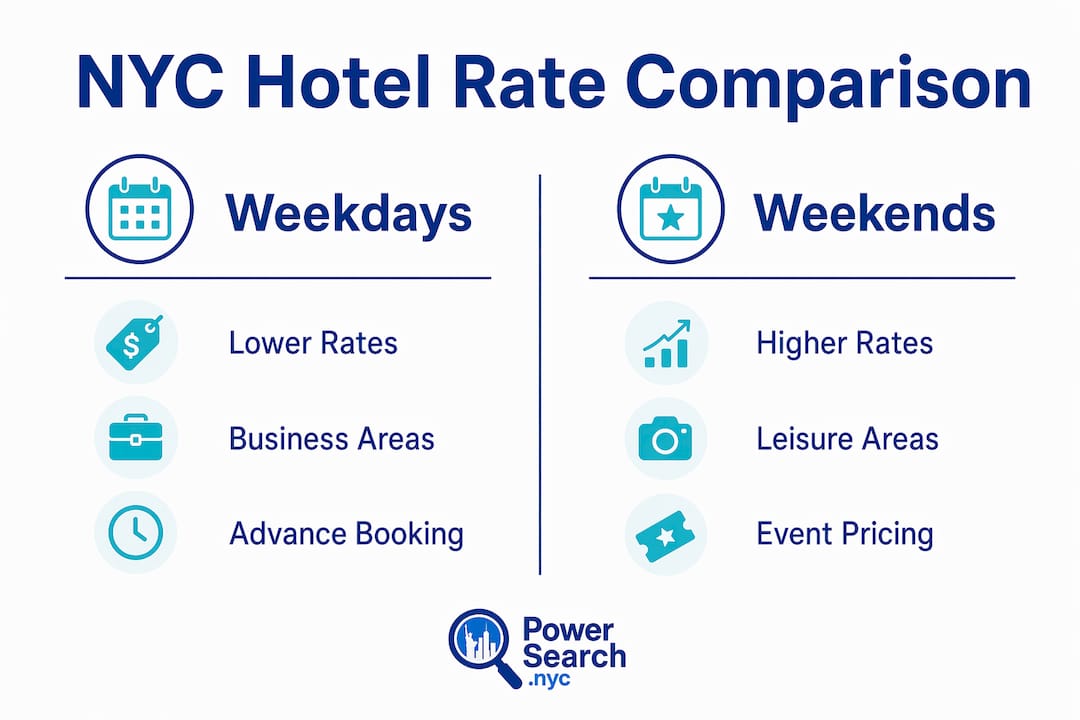
NYC hotels charge a sustained 33% weekend premium over weekday rates, with Manhattan’s average daily rate sitting at $283 on weekdays versus $349 on weekends according to a 90-day market scan from May 2026. That gap is not random. It reflects a city where corporate travelers fill rooms Monday through Thursday, then clear out on Friday, handing the market over to leisure visitors who are far less price-sensitive. Understanding NYC weekday vs weekend hotel rates means knowing which neighborhoods follow this pattern, which ones flip it entirely, and exactly when to book to pay less than the average traveler.
How do NYC weekday and weekend hotel rates compare by neighborhood?
The pricing gap between weekdays and weekends is not uniform across New York City. Where you stay matters as much as when you stay, and the difference can be dramatic.
Business-heavy corridors like Midtown East and the Financial District follow a pattern that surprises most first-time visitors. Hotels in these areas fill up Monday through Thursday with corporate guests on company expense accounts. When those guests leave on Friday, demand collapses. To fill rooms, business hotels discount weekends aggressively. That means a sleek Midtown East property that charges $320 on a Tuesday night might drop to $240 on a Saturday. For leisure travelers, this is genuinely good news.

Leisure-focused areas tell a completely different story. Times Square and Midtown West attract tourists year-round, and those visitors peak on weekends. Hotels in these zones have no incentive to discount Saturday nights because demand stays strong. The NYC weekday-weekend price inversion is one of the most misunderstood dynamics in travel planning. Travelers who assume “weekends are always cheaper” get burned when they book a Times Square hotel for a Friday arrival.
Here is a practical snapshot of how rates typically shift by neighborhood and day type:
| Neighborhood | Weekday rate trend | Weekend rate trend | Best for |
|---|---|---|---|
| Midtown East | Higher (corporate demand) | Lower (discounted) | Leisure travelers on weekends |
| Financial District | Higher Mon–Thu | Lower Fri–Sun | Budget-conscious weekend visitors |
| Times Square / Midtown West | Moderate | Higher (leisure peak) | Flexible travelers who avoid Fri/Sat |
| Lower East Side / Brooklyn | Moderate | Moderate to higher | Travelers with flexible schedules |
Pro Tip: If your schedule allows, book a business-district hotel for a Saturday or Sunday night. You get a premium property at a leisure price, and you are still close to everything Manhattan has to offer.
What booking timing and arrival day do to your total hotel cost
Most travelers focus on nightly rate. That is the wrong number to watch. Total stay cost by arrival day is the figure that actually determines what you spend, and shifting your arrival by even one day can unlock real savings.
The optimal booking window for NYC domestic travelers is 14 to 21 days before check-in. Book too early and you pay inflated rack rates. Book too late and inventory shrinks. That 14 to 21 day window is where the market tends to price most competitively for standard leisure stays.
Last-minute bookings can save you up to 26%, but the risk is real. If a major event hits the city that weekend, rates spike and availability disappears. The smarter play is to book within the optimal window, then monitor rates and rebook if prices drop before your arrival. Many hotels allow free cancellation up to 24 to 48 hours out, which makes this strategy low-risk.
Here is a step-by-step approach to booking a NYC hotel stay strategically:
- Decide your neighborhood first. Business district or leisure zone? That single choice shapes your entire pricing strategy.
- Check rates for a Sunday arrival instead of Friday. Sunday nights are consistently cheaper, and the savings compound across a multi-night stay.
- Set a rate alert 21 days before travel. Use Powersearch or a hotel aggregator to track price movement on your target property.
- Book a refundable rate within the 14 to 21 day window. Lock in a competitive price while keeping flexibility.
- Recheck rates 5 to 7 days out. If prices dropped, cancel and rebook. If they rose, you are already protected.
Pro Tip: Shifting your arrival from Friday to Sunday can reduce your total stay cost significantly, even when the nightly average looks similar. Sunday arrivals often unlock the lowest rates of the week in both business and leisure zones.
How event-driven pricing and volatility affect NYC weekend rates
The 33% average weekend premium is just the baseline. On certain weekends, rates go far beyond that. Manhattan hotel weekends show spikes as high as +149% from base rates when local events compress available inventory. The combined ADR volatility across the Manhattan market sits at 33.9%, which means relying on seasonal averages to budget your trip is genuinely unreliable.
NYC hotels now use AI-driven dynamic pricing that reacts to real-time demand compression from local events, conferences, and even weather patterns. A marathon, a major concert at Madison Square Garden, or a fashion week event can push rates at nearby hotels to levels that bear no resemblance to the previous weekend’s prices. This is not a quirk. It is the standard operating model for Manhattan hotels in 2026.
Here is what that volatility looks like in practice:
| Pricing scenario | Typical ADR impact | Trigger |
|---|---|---|
| Standard weekend premium | +33% over weekday ADR | Normal leisure demand |
| Event compression weekend | Up to +149% over base | Marathon, fashion week, major concerts |
| Low-demand Sunday night | Below weekday ADR | Post-event, low occupancy |
| Holiday weekend | +50% to +80% estimated | Thanksgiving, July 4th, New Year’s |
“The Manhattan hotel market’s sharp weekly ADR volatility requires travelers to regularly monitor rates and adapt bookings dynamically rather than relying on static pre-planned budgets.” — RevPARGenius Manhattan Market Analysis 2026
The practical takeaway is simple. If you know a major event is happening in the city during your planned visit, book earlier than the standard 14 to 21 day window. For event weekends, rates can lock in at elevated levels weeks in advance, and waiting only costs you more. Check the NYC events calendar before you set your travel dates. That one step can save you hundreds of dollars. You can also read more about how rate fluctuation works to understand the mechanics behind these swings.
How NYC hotel costs compare nationally and what to expect in 2026
New York hotel prices exist in a category of their own. The NYC average daily rate in 2025 was $334, more than double the U.S. national average of $158. That gap reflects land costs, labor costs, and the sheer density of demand in a city that draws over 60 million visitors annually. For travelers budgeting a NYC trip, the national average is simply not a useful reference point.
Rates are projected to climb further in 2026. Labor contracts negotiated with hotel unions are expected to push operating costs up roughly 15%, and hotels will pass those increases to guests. The pressure lands unevenly across the week. Weekday rates in business districts are somewhat cushioned by corporate travel budgets, but leisure weekend rates at Times Square properties have less resistance to price increases since tourists tend to absorb higher costs.
Here is what this means for your 2026 trip budget:
- Set a realistic floor. Budget at least $250 to $300 per night for a decent midrange Manhattan hotel on a weekday, and $330 to $380 on a weekend in a leisure zone.
- Factor in fees. Resort fees, destination charges, and taxes can add $40 to $80 per night on top of the advertised rate.
- Consider outer boroughs. Brooklyn and Queens hotels often run $80 to $120 less per night than comparable Manhattan properties, with easy subway access.
- Watch for early booking advantages. Locking in rates before the 2026 labor cost increases fully filter through the market can protect your budget. Powersearch’s guide on early booking savings breaks this down in detail.
Key takeaways
NYC weekday vs weekend hotel rates differ by an average of 33%, but neighborhood type, event calendars, and booking timing determine whether you pay above or below that average.
| Point | Details |
|---|---|
| Weekend premium is real | Manhattan weekend ADR averages $349 vs $283 on weekdays, a 33% gap. |
| Neighborhood type flips the pattern | Business districts like Midtown East discount weekends; leisure zones like Times Square do not. |
| Arrival day beats nightly average | A Sunday arrival often costs less than Friday, reducing total stay cost meaningfully. |
| Event weekends spike sharply | Rate spikes up to +149% occur during high-demand events; book early when events are known. |
| NYC rates far exceed national norms | At $334 average daily rate, NYC runs more than double the U.S. national average of $158. |
What I’ve learned from watching NYC hotel rates closely
Here is something most generic travel advice gets wrong. People treat NYC hotel pricing like a single market with one set of rules. It is not. It is dozens of micro-markets stacked on top of each other, each responding to a different type of traveler demand.
The travelers I see overpay most consistently are the ones who book a Times Square hotel for a Friday night arrival without checking the Financial District alternatives. They pay a leisure premium at a property that is genuinely chaotic on weekends, when they could have stayed in a quieter, nicer business hotel for $80 less per night. The hotel price comparison tips that actually move the needle are about neighborhood selection, not just timing.
The other mistake I see constantly is ignoring total stay cost in favor of nightly averages. A hotel that looks like $280 per night on average might be $220 on Sunday and $340 on Friday. If you arrive Sunday and leave Wednesday, you pay far less than the traveler who arrives Friday. That math is not complicated, but most people never run it.
My honest recommendation: check rates 21 days out, set an alert, and recheck 5 days before travel. Mix a business district hotel for your weekend nights with a leisure-zone property for your weekday sightseeing days if your itinerary allows it. That combination consistently delivers the best value in a city where the average hotel night costs more than twice the national norm.
— Mark
Plan your NYC stay smarter with Powersearch
Ready to put this knowledge to work? Powersearch makes it easy to compare NYC weekday and weekend hotel rates side by side, filter by neighborhood, and find properties that match your budget and travel style.

Whether you are looking for affordable Manhattan deals or planning a family trip and need suite-style space, Powersearch has the tools to help you book with confidence. The NYC hotel suite guide for families is a great starting point if you need more room without paying luxury prices. And if Times Square is on your list, check out the best hotels near Times Square to find options that balance location and value. Start your search at Powersearch NYC and drop your bags ready to explore.
FAQ
Are NYC hotels cheaper on weekdays or weekends?
Weekdays are generally cheaper in business-heavy neighborhoods like Midtown East and the Financial District, where weekday ADR averages $283 versus $349 on weekends. In leisure zones like Times Square, weekends often stay elevated or rise further due to tourist demand.
What is the best time to book an NYC hotel for the lowest rate?
The optimal booking window is 14 to 21 days before check-in, where rates tend to be most competitive. Last-minute bookings can save up to 26% if you are flexible, but availability shrinks fast during event weekends.
Does arriving on a Sunday really save money in NYC?
Yes. Sunday arrivals consistently unlock lower nightly rates compared to Friday or Saturday arrivals, and the savings compound across a multi-night stay. Tracking total stay cost by arrival day, rather than nightly averages, is the smarter way to budget.
How much more expensive is NYC compared to other U.S. cities?
NYC’s average daily hotel rate was $334 in 2025, more than double the U.S. national average of $158. Labor cost increases from union contracts are projected to push 2026 rates higher across both weekday and weekend categories.
Can NYC hotel rates spike dramatically on certain weekends?
Absolutely. Manhattan hotel weekends tied to major events like marathons, fashion week, or large concerts have shown rate spikes as high as +149% above base rates. If you know your travel dates overlap with a major event, book well outside the standard 14 to 21 day window.
No Comments