

Best Manhattan Areas to Stay for Leisure Travelers
Disclosure: This post may contain affiliate links. We may earn a commission for purchases made through links in this post, at no cost to you.
Choosing where to sleep in Manhattan is one of the most consequential decisions you’ll make for your trip, and most travelers get it wrong. The best Manhattan areas to stay aren’t just about being close to Times Square. Manhattan has over 40 distinct neighborhoods, each with its own price point, personality, and proximity to the things you actually want to do. Pick the wrong one and you’ll spend your mornings riding the subway instead of exploring. Pick the right one and you’ll step outside feeling like you belong there.
Table of Contents
- Manhattan neighborhoods by price: budget-friendly to premium
- Match your lifestyle: choosing neighborhoods by vibe and amenities
- Staying close to Manhattan’s top attractions and transportation hubs
- Hidden gems and smart alternatives around Manhattan
- A fresh take on choosing Manhattan neighborhoods for your stay
- Find your perfect hotel in Manhattan today
- Frequently asked questions
Key Takeaways
| Point | Details |
|---|---|
| Know price tiers | Manhattan neighborhoods range from budget-friendly to premium, significantly impacting accommodations. |
| Match your lifestyle | Choose neighborhoods that fit your personality and desired amenities for a better stay experience. |
| Prioritize location | Proximity to major attractions and transit hubs can maximize sightseeing and minimize travel time. |
| Consider hidden gems | Explore authentic neighborhoods and nearby boroughs for quieter, affordable, and value stays. |
| Use expert tools | Leverage hotel search platforms tailored to Manhattan for confident and convenient booking decisions. |
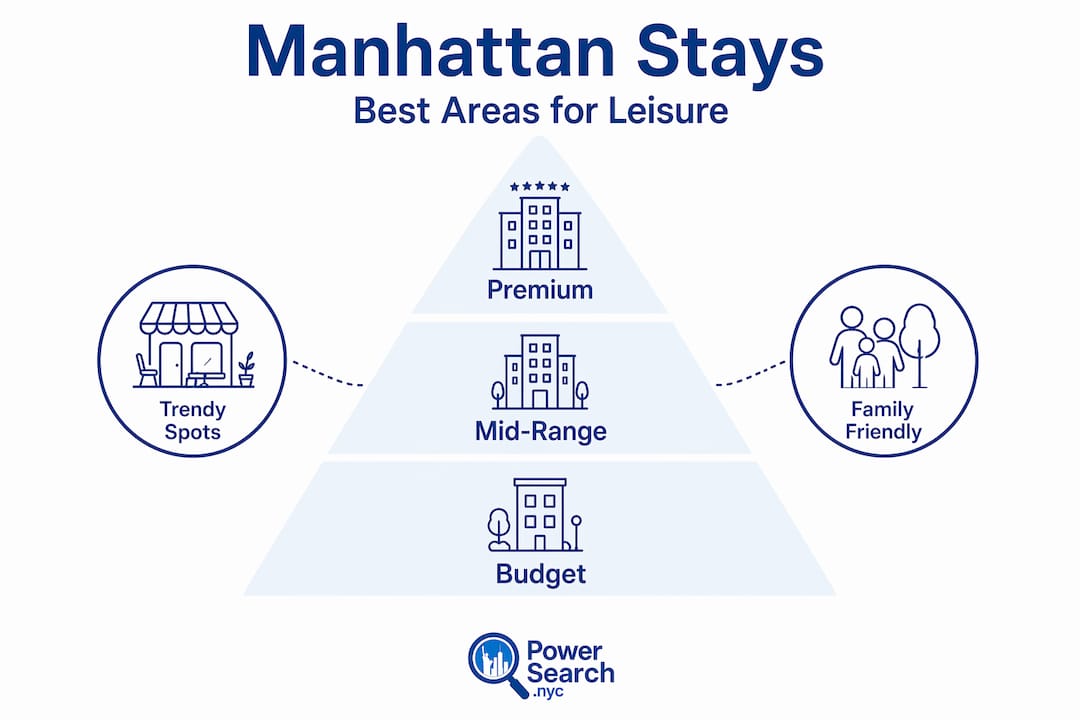
Manhattan neighborhoods by price: budget-friendly to premium
Your hotel budget doesn’t just determine where you sleep. It determines which neighborhood you wake up in, and that shapes everything from your morning coffee walk to how far you are from the subway. Neighborhood price tiers in Manhattan break down into three clear categories, and knowing where you fall helps you set realistic expectations before you even start searching.
Budget-friendly neighborhoods sit in upper Manhattan. Washington Heights, Inwood, and East Harlem typically have lower hotel rates because they’re further from the tourist core. Average rents of $2,700 to $3,500 in these areas signal to hotels that locals here are price-conscious, and rates follow. You’ll find cleaner, quieter streets, great food, and you’re still on the subway grid. East Harlem in particular has seen a wave of renovated boutique stays in recent years.
Mid-range neighborhoods are where most first-time visitors land. Hell’s Kitchen and Murray Hill sit comfortably in the $3,500 to $5,500 rent range and offer solid value. Hell’s Kitchen, just west of Midtown, is packed with restaurants, bars, and is an easy walk to Broadway theaters. Murray Hill skews younger and quieter. Both give you Midtown access without Midtown prices.
Premium neighborhoods are a different world. Tribeca, Hudson Yards, and West Village carry rents above $7,000 per month, and hotels there price accordingly. But what you get is space, design, calm streets, and a neighborhood that feels genuinely lived in by people who care about it. If you want luxury hotels in Manhattan, these are the ZIP codes.
| Neighborhood | Price tier | Vibe | Best for |
|---|---|---|---|
| Washington Heights | Budget | Residential, local | Value seekers |
| East Harlem | Budget | Cultural, up-and-coming | Culture travelers |
| Hell’s Kitchen | Mid-range | Lively, restaurant-heavy | Foodies, theater fans |
| Murray Hill | Mid-range | Quieter, walkable | Young couples |
| Midtown | Mid-range to premium | Central, busy | First-time visitors |
| West Village | Premium | Charming, boutique | Romantic getaways |
| Tribeca | Premium | Sleek, quiet | Luxury travelers |
| Hudson Yards | Premium | Modern, curated | Design lovers |
Pro Tip: If you find affordable Manhattan hotel deals in mid-range neighborhoods, book early. Hell’s Kitchen especially fills fast around Broadway season and summer weekends.
Now that you understand Manhattan’s price tiers, let’s explore neighborhoods suited to different traveler lifestyles and interests.
Match your lifestyle: choosing neighborhoods by vibe and amenities
Price matters, but it’s only half the equation. Two neighborhoods with similar hotel rates can feel completely different depending on the energy, the streets, and what’s open at midnight. The smartest way to choose your NYC neighborhood is to be honest about how you actually travel.
Young travelers and social explorers tend to gravitate toward the Lower East Side and Flatiron. The Lower East Side has rooftop bars, late-night spots, and a creative, unpretentious crowd. Flatiron puts you near Madison Square Park, a jaw-dropping density of restaurants, and fast access to both Midtown and downtown. These areas have energy from morning to well past midnight.

Families need different things entirely. The Upper West Side is a strong pick. You’ve got Central Park a few blocks away, safe and tree-lined streets, the Natural History Museum, and residents who are mostly long-term New Yorkers with kids. The Upper East Side offers similar calm, with the added bonus of Museum Mile, which includes the Metropolitan Museum of Art. Family-friendly hotels in Manhattan in these areas often have connecting rooms and suites, which makes a real difference.
Greenwich Village is the neighborhood for travelers who want to feel like they’ve actually lived in New York for a week. Tree-lined blocks, jazz clubs, independent bookstores, and a relaxed pace that you rarely find this close to Midtown. You’ll see locals walking their dogs at 7am, which is a better sign of neighborhood health than any review site rating.
Here’s a quick breakdown by lifestyle:
- You love nightlife: Lower East Side, Hell’s Kitchen, East Village
- You want peace and culture: Greenwich Village, Upper West Side
- You’re traveling with family: Upper East Side, Upper West Side, Murray Hill
- You want luxury and calm: Tribeca, West Village, Hudson Yards
- You’re on a budget but want character: East Harlem, Washington Heights
Pro Tip: Don’t book a hotel in a neighborhood based on how it looks in photos. Look up what’s within a five-minute walk. If the nearest restaurant is a chain, keep searching.
Understanding your lifestyle preferences helps narrow neighborhoods. Next, we look at proximity to attractions and transportation.
Staying close to Manhattan’s top attractions and transportation hubs
No matter how much you love your neighborhood, you’re going to spend time getting around. Manhattan’s subway is genuinely excellent, but the closer you are to major hubs and attractions, the less time you waste in transit.
Midtown Manhattan is the top recommendation for first-time visitors because it concentrates everything. The Empire State Building, Bryant Park, Rockefeller Center, the Museum of Modern Art, Fifth Avenue shopping, and major theater districts are all within walking distance of each other. If you stay in Midtown, you can genuinely walk to most of what’s on a typical tourist itinerary.
Times Square itself is the most central but also the most chaotic. The full sensory overload experience is real. Screens everywhere, crowds at all hours, street performers at midnight. If you want hotels near Times Square without sleeping inside the noise, book on the eastern or western edges of the square rather than directly on Broadway between 42nd and 47th.
Midtown East is a smarter alternative. It’s quieter, more business-oriented, and still puts you within a 10-minute walk of Grand Central Terminal, which connects to the 4, 5, 6, 7, and S subway lines. That gives you reach across the entire island. Midtown is heavily patrolled and well-lit, which is reassuring for travelers unfamiliar with New York’s street layout.
Here’s what to prioritize when choosing based on location:
- Identify your top three attractions and map them.
- Find the subway lines that connect them.
- Choose a neighborhood that sits on or near those lines.
- Check walking times from your hotel to the nearest station.
- Verify the station has the service lines you need, not all stations serve all lines.
| Midtown subarea | Noise level | Safety | Attraction density |
|---|---|---|---|
| Times Square core | Very high | High | Very high |
| Midtown East | Low to moderate | High | High |
| Hell’s Kitchen | Moderate | High | Moderate to high |
| Midtown South/Murray Hill | Low | High | Moderate |
Use the hotel search in Manhattan to filter specifically by neighborhood and subway proximity. It saves a lot of guesswork.
With budget, lifestyle, and location factors covered, let’s examine some hidden gems and overlooked options in and around Manhattan.
Hidden gems and smart alternatives around Manhattan
Here’s something most travel guides won’t tell you: seasoned travelers skip Midtown. They choose West Village, Upper West Side, or other residential neighborhoods because they want to experience the city the way people actually live in it. Fewer tourists. Quieter mornings. Better coffee shops. The trade-off is that hotels in these areas are either scarce, boutique-only, or priced at a premium because demand is high and supply is low.
But if you want real neighborhood character without paying West Village prices, consider going just outside Manhattan. Long Island City in Queens and Downtown Brooklyn are the two smartest alternatives for value travelers. Both have direct subway lines into Midtown. Long Island City is about a 10-minute ride to Grand Central. Downtown Brooklyn puts you about 20 minutes from most of lower Manhattan and midtown.
“Staying outside Manhattan doesn’t mean you’re outside New York. Long Island City and Downtown Brooklyn are fully urban, fully convenient, and often 20 to 40 percent cheaper per night than comparable Midtown hotels.”
Here’s what you gain by going slightly outside Manhattan:
- Lower nightly rates with no meaningful sacrifice in access
- Bigger hotel rooms, since space is less at a premium
- Calmer streets that help you actually decompress after a full day
- Authentic local neighborhood feel rather than a tourist corridor
Use the NYC neighborhood guide on PowerSearch NYC to compare these options side by side. And check affordable hotel deals for current rates in outer-borough neighborhoods that still give you easy Manhattan access.
After exploring well-known and hidden neighborhood options, here’s a fresh perspective on how to actually make this decision with confidence.
A fresh take on choosing Manhattan neighborhoods for your stay
Most neighborhood rankings you’ll find online are based on universal popularity. Times Square ranks high because it’s famous, not because it’s the best place to stay. That distinction matters more than most travelers realize before they book.
Choosing a neighborhood is really about matching where you stay to who you are as a traveler, not chasing a ranking. If you’re someone who likes to be out until 2am and sleep until noon, the quiet streets of the Upper East Side will feel like a mistake by day two. If you need peace and sleep to enjoy anything, Times Square will wear you out before you’ve seen half of what you came for.
The uncomfortable truth is that convenience and authenticity are often in direct tension with each other. The more central and convenient a neighborhood is, the more it caters to visitors rather than locals. You pay more, you get less character, and you share every sidewalk with a tour group. Moving 10 blocks in the wrong direction on a map can mean moving 10 years back in time in terms of neighborhood feel.
Smart travelers think about three trade-offs: price versus atmosphere, convenience versus quiet, and central location versus local experience. You rarely get all three in the same zip code. Decide which two matter most to you, then optimize for those.
Pro Tip: Before booking, spend 15 minutes on street-level mapping of your shortlisted hotels. Look at what’s actually on the block. A hotel surrounded by chain pharmacies and parking garages tells a different story than one surrounded by restaurants and bookstores. That context shapes your whole experience.
Use our guide to choosing Manhattan neighborhoods to think through these trade-offs before you commit to a booking.
Find your perfect hotel in Manhattan today
You’ve now got a real framework for thinking about Manhattan neighborhoods, not just a list of places someone else liked. You know how price tiers work, which neighborhoods match your lifestyle, where to stay for attraction access, and when it makes sense to look just outside Manhattan for better value.

PowerSearch NYC makes the next step easy. Use the hotel search in Manhattan to filter by neighborhood, price range, amenities, and proximity to attractions. Whether you want a family suite near Central Park, a boutique hotel in the West Village, or a budget-friendly room with fast subway access, the filters are built specifically to match the kind of decision-making this guide walked you through. Explore best hotels near Times Square or use the full NYC neighborhood guide to keep researching before you book.
Frequently asked questions
What are some affordable Manhattan neighborhoods for leisure travelers?
Washington Heights, Inwood, and East Harlem are your best bets for keeping costs down. These areas have lower average rents of $2,700 to $3,500, which keeps hotel rates more accessible than in central Manhattan without putting you far from the subway.
Which Manhattan neighborhood is best for first-time visitors?
Midtown Manhattan is the clear answer. It’s recommended for first-timers because of its dense concentration of major attractions and its unmatched subway connectivity, so you spend less time commuting and more time exploring.
Are there safer neighborhoods in Manhattan for tourists?
Yes. Midtown Manhattan is among the safest because it’s heavily patrolled and well-lit around the clock. Battery Park City, Tribeca, and the Upper East Side are also consistently regarded as safe, family-friendly areas.
Can staying outside Manhattan be a good choice?
Absolutely. Long Island City and Downtown Brooklyn both offer better value with a quick subway commute to Midtown, making them smart picks if you want more space or a lower nightly rate without giving up convenience.
What factors should I consider when choosing a Manhattan neighborhood?
Start with your budget, then layer in lifestyle preferences, nightlife or park access, family needs, and how far you’re willing to commute to major attractions. Your final choice depends on which combination of those factors matters most to you personally.
No Comments