

NYC Hotel Tier Classification Explained for Travelers
Disclosure: This post may contain affiliate links. We may earn a commission for purchases made through links in this post, at no cost to you.
NYC hotel tier classification is the system that groups New York City hotels by star level, service quality, and amenities to help travelers choose the right stay for their budget and expectations. The system is not government-mandated. Instead, it draws from industry standards set by bodies like Forbes Travel Guide and AAA, plus self-assigned ratings common across U.S. booking platforms. With over 124,000 hotel rooms spread across five boroughs and an average daily rate of $334 in 2025, more than double the national average of $158, knowing what each tier actually delivers is the difference between a great trip and a frustrating one.
What are the NYC hotel tier classification levels?
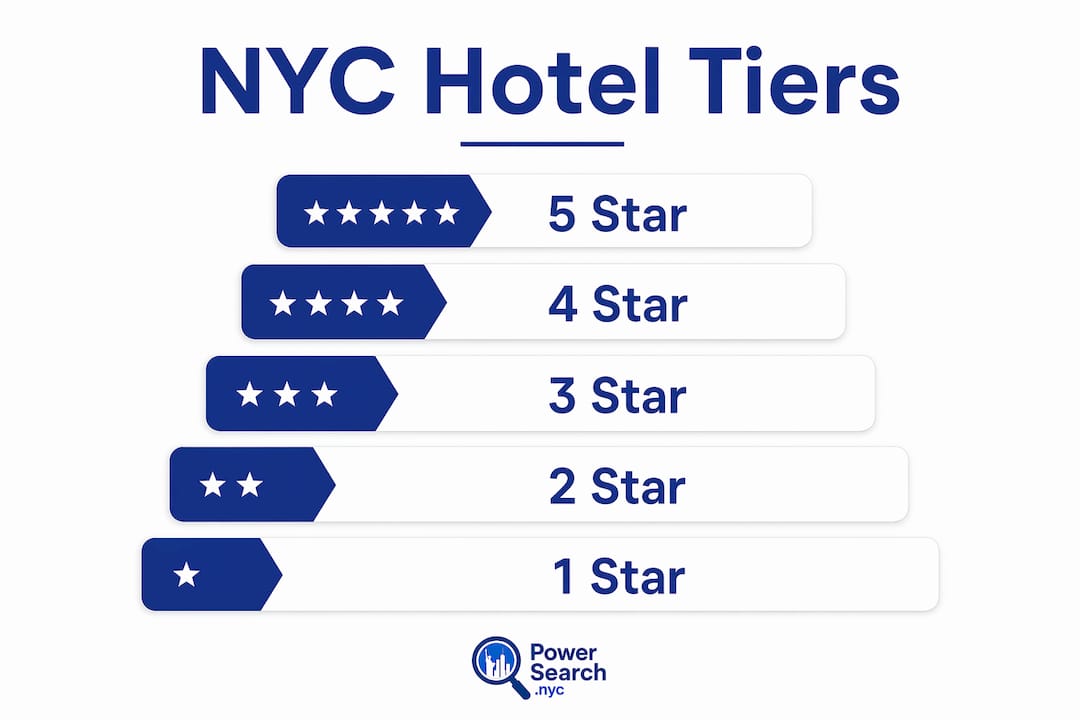
NYC hotel tiers follow the standard 1–5 star framework used across the U.S., but the city’s size and density create real differences within each level. Star ratings mark a category, not a guarantee of quality. Two hotels with the same star count can feel completely different in practice.
Here is what each tier typically delivers in New York City:
- 1 star: Basic private rooms, shared or private bathrooms, minimal front desk hours. Think small walk-up properties in outer neighborhoods. No frills, but clean and functional for budget travelers.
- 2 star: Private bathrooms standard, limited amenities like a small lobby or vending area. Often found in Queens and parts of Brooklyn. Good for travelers who plan to spend most of their time out exploring.
- 3 star: The most common tier in NYC. Expect ensuite rooms, daily housekeeping, a 24-hour front desk, and basic fitness access. Properties in this range sit in Midtown and Downtown Manhattan as well as central Brooklyn.
- 4 star: Elevated service with longer front desk coverage, a gym, room service, and higher-quality furnishings. Many 4-star properties in Midtown offer concierge services and on-site dining. These are the go-to for business travelers and comfort-focused visitors.
- 5 star: Full personalized service, multiple dining outlets, spa facilities, premium bedding, and concierge available around the clock. Properties like those on the Upper East Side or in Midtown set the standard here. The experience is curated from check-in to checkout.
Pro Tip: Book a 3-star hotel in a central neighborhood over a 2-star in Midtown. Location often adds more value than the extra amenity or two you get by upgrading.
Many NYC hotels self-assign their star ratings without independent verification. That means a hotel calling itself 4 stars may not meet the same bar as a Forbes-inspected property. Always cross-check the star label with recent guest reviews before booking.

How does NYC hotel classification differ from other systems?
The U.S. hotel rating system works very differently from what you find in Europe or Asia. Understanding that gap saves you from misreading a star label when comparing options.
- No government standard exists in the U.S. Hotels in France, Germany, and the UK operate under national classification schemes with defined criteria. American hotels face no such requirement. A hotel can call itself 4 stars without any external audit.
- OTA algorithms fill the gap. Online travel agencies assign star ratings based on amenity checklists, not service quality assessments. A hotel with a pool and a gym may score higher than a smaller property with exceptional personalized service.
- Forbes Travel Guide weighs service at 67%. The Forbes scoring system puts the majority of its score on service quality, not room size or elevator count. European systems often do the opposite, focusing on physical facilities. That difference matters a lot in NYC, where boutique hotels with small rooms but outstanding staff can outperform larger properties.
- Michelin Key is an emerging benchmark. Michelin expanded its hotel recognition program to the U.S., adding another independent voice for travelers who want verified quality signals beyond star counts.
- Guest reviews from the last 90 days beat star ratings. Recent review data predicts actual experience better than any star label, especially in U.S. markets where self-assignment is common.
Pro Tip: Filter by guest score, not just star rating, when searching NYC hotels. A 4.5-star guest score on a 3-star property often beats a 3.8-star score on a 4-star one.
Hybrid and boutique hotels complicate the picture further. A boutique property in the West Village may offer a curated art collection, locally sourced breakfast, and a genuinely attentive team, yet carry only a 3-star label because it lacks a pool or a ballroom. The NYC hotel rating guide you use matters as much as the rating itself.
How do location and pricing relate to hotel tiers in NYC?
Location shapes what you pay for a given tier more than almost any other factor. The same quality of room costs dramatically different amounts depending on which borough you choose.
NYC’s average daily rate of $334 reflects Midtown Manhattan’s dominance in the market. Rates in january and february run 30–40% cheaper than in september and october, when demand peaks. That seasonal swing is one of the most reliable ways to stretch your budget without dropping a tier.
| Tier | Midtown Manhattan | Brooklyn | Queens |
|---|---|---|---|
| 2 star | $150–$200 | $90–$130 | $80–$110 |
| 3 star | $260–$380 | $140–$220 | $120–$180 |
| 4 star | $380–$550 | $220–$320 | $190–$270 |
| 5 star | $550+ | Limited options | Limited options |
Midtown rates range from $260 to $380 for a standard 3-star stay, while Brooklyn offers comparable quality for $140 to $220. That gap is real and consistent. Travelers who choose Brooklyn over Manhattan at the same tier save 40–50% on their nightly rate. Queens goes even further, with strong subway access making it a practical base for visitors who want to cover the whole city.
A few practical tips for getting the most out of your tier choice:
- Stay in Brooklyn or Long Island City in Queens for 3-star quality at 2-star prices.
- Travel in january, february, or early march for the steepest discounts across all tiers.
- Check weekday vs. weekend rates before booking. Business-heavy Midtown hotels often drop rates on weekends.
- Prioritize proximity to a subway line over proximity to a landmark. NYC transit makes location flexible.
Understanding how room rates fluctuate by season and neighborhood helps you pick the right tier at the right price, rather than overpaying for a star label in a premium zip code.
What emerging hotel types are changing NYC tier classifications?
The traditional 1–5 star framework was built for a different era of travel. NYC’s hotel market has moved well beyond it, and travelers who rely only on star counts miss some of the best stays in the city.
Hybrid boutique hotels combine features of extended-stay properties, design-forward boutiques, and traditional city hotels. They often include co-working spaces, curated local experiences, and app-based check-in. None of those features show up on a standard star rating checklist.
Here is what defines the best emerging hotel types in NYC:
- Design consistency: Every room, hallway, and common area reflects a deliberate aesthetic. This signals investment in the guest experience beyond basic amenities.
- Digital services: Mobile check-in, keyless entry, and in-app concierge are now standard at higher-end boutique properties. These features improve the stay without adding traditional 4-star overhead.
- Curated local programming: Rooftop events, neighborhood walking guides, and partnerships with local restaurants give boutique hotels a personality that a standard 4-star chain property rarely matches.
- Personalized service at scale: The best boutique hotels in NYC focus on experience consistency rather than star benchmarks. Staff know repeat guests by name. That kind of attention is hard to quantify in a star rating.
Pro Tip: When evaluating a boutique hotel, check whether it has been recognized by Forbes Travel Guide or Michelin Key. Those independent inspections confirm service quality in a way that self-assigned stars cannot.
NYC’s most luxurious boutique hotels often outperform standard 4-star chain properties in guest satisfaction, even when they carry a lower star count. The lesson is simple: evaluate the full picture, not just the number.
Key Takeaways
NYC hotel tier classification is most useful when combined with independent review scores, location context, and an understanding of how U.S. self-assignment practices differ from verified rating systems like Forbes Travel Guide.
| Point | Details |
|---|---|
| Stars are not standardized | U.S. hotels self-assign ratings; no government body enforces star criteria. |
| Forbes weighs service heavily | Forbes Travel Guide assigns 67% of its score to service quality, not room size. |
| Location shifts pricing sharply | Brooklyn hotels cost 40–50% less than Manhattan at the same tier level. |
| Recent reviews beat star labels | Guest reviews from the last 90 days predict actual experience better than stars. |
| Boutique hotels challenge old tiers | Hybrid NYC properties often deliver 4-star experiences under a 3-star label. |
What I’ve learned after years of watching NYC hotel tiers shift
The star rating system in NYC has always been a rough guide at best. What I’ve found after years of tracking this market is that travelers who fixate on the star number often end up disappointed, while those who dig one layer deeper almost always find better value.
The most reliable signal I’ve seen is the combination of a Forbes or Michelin-recognized property and a strong recent guest score. When both align, the stay almost always delivers. When only one does, you’re taking a chance.
The outer borough angle is genuinely underused. I’ve stayed in 3-star Brooklyn properties that felt more considered and comfortable than 4-star Midtown hotels charging twice the rate. The subway ride into Manhattan takes 20 minutes. The savings on a week-long trip can fund an extra night or a serious dinner out.
My honest advice: treat the star rating as a starting point, not a verdict. Read the most recent 20 reviews, check whether the property has any independent recognition, and look hard at the location relative to what you actually plan to do in the city. That process takes 10 minutes and saves real money and real frustration. For luxury Manhattan stays, the 5-star tier genuinely earns its price when service is the priority. For everyone else, the 3-star tier in a well-located neighborhood is where NYC’s best value lives.
— Mark
Plan your NYC stay with Powersearch
Knowing how hotel tiers work is only half the job. Finding the right property at the right price takes a search tool that actually reflects those distinctions.

Powersearch lets you filter NYC hotels by tier, neighborhood, price range, and amenities in one place. Whether you’re after a budget-friendly stay in Brooklyn or a full-service 5-star experience in Midtown, the platform surfaces options that match your actual priorities. Use the NYC hotel search to compare properties side by side and book with confidence, knowing exactly what each tier delivers before you arrive.
FAQ
What is the NYC hotel tier classification system?
NYC hotel tier classification groups hotels into 1–5 star levels based on amenities, service quality, and facilities. The system is not government-mandated in the U.S., so ratings often reflect self-assignment or OTA algorithms rather than independent inspection.
Are NYC hotel star ratings verified by anyone?
Independent bodies like Forbes Travel Guide and Michelin Key verify a small number of NYC hotels through anonymous inspections. Most hotels assign their own star ratings without any external audit.
Why are NYC hotel rates so much higher than the national average?
NYC’s average daily rate of $334 is more than double the U.S. national average of $158, driven by high demand, limited space, and the concentration of premium properties in Manhattan.
How can I save money without dropping hotel quality in NYC?
Choosing Brooklyn or Queens over Manhattan at the same star tier cuts costs by 40–50% without sacrificing comfort. Traveling in january or february also delivers 30–40% lower rates across all tiers.
Do boutique hotels fit into the standard NYC hotel rating guide?
Boutique hotels often fall outside traditional star metrics because they prioritize curated experiences and digital services over physical amenity checklists. A boutique property may carry a 3-star label while delivering a guest experience that rivals standard 4-star hotels.
No Comments