

NYC Hotel Expense Reporting: How It Works in 2026
Disclosure: This post may contain affiliate links. We may earn a commission for purchases made through links in this post, at no cost to you.
NYC hotel expense reporting is the practice of documenting and itemizing lodging charges, taxes, and fees on travel expense reports to meet IRS substantiation rules and corporate reimbursement policies. Business travelers and finance professionals dealing with New York City hotel stays face a uniquely complex process. The city’s layered tax structure, bundled hotel charges, and new 2026 pricing transparency laws all affect how you report and get reimbursed. Get this wrong, and your expense report gets rejected automatically. Get it right, and reimbursement moves fast with no audit flags.
How NYC expense reporting for hotels works: the core process
NYC hotel expense reporting follows a structured process: collect an itemized folio at checkout, separate every charge by category, apply correct general ledger (GL) codes, and submit within your company’s deadline. The IRS defines this process through its substantiation rules, which require an itemized receipt for all lodging expenses regardless of amount, and for any other expense over $75. A credit card statement alone does not satisfy this requirement. That distinction trips up more business travelers than almost any other rule.
The full folio from your hotel is the document that matters. It lists every charge by date, including room rate, taxes, meals, parking, and incidentals. Your finance team needs this document, not just a line item showing a lump sum paid to a Midtown hotel. IRS substantiation rules treat lodging as a special category, meaning the itemized folio requirement applies even for a one-night stay under $75.
What are the documentation and receipt requirements for NYC hotel expense reports?
The most common mistake business travelers make is submitting a credit card transaction line instead of a full itemized folio. Automated expense systems now reject these submissions outright. Finance teams have configured their platforms to flag any lodging submission without a line-by-line breakdown.
Here is what a compliant NYC hotel expense report requires:
- Itemized folio: A document from the hotel listing every charge by date and category, not a summary receipt.
- Separated bundled charges: Room rate, meals, internet, parking, and incidentals must each appear as individual line items. Bundled hotel charges submitted as a single amount cause GL coding errors and trigger audits.
- Correct GL codes: Each charge category maps to a different account. Lodging, meals, and incidentals are not interchangeable.
- Dates for each charge: Multi-night stays require a separate entry for each night, not one total.
- Tax and fee breakdown: NYC hotel taxes and mandatory fees must appear separately from the room rate.
When a receipt goes missing, a Missing Receipt Affidavit combined with a credit card statement can satisfy internal company policy. However, the IRS may still deny deductions without the original itemized folio. That means your company might reimburse you, but the deduction could be disallowed in an audit. Always request your folio at checkout, or ask the hotel to email it within 24 hours.
Pro Tip: Request your itemized folio the night before checkout. Most NYC hotels will email it to you by 7:00 AM on your departure day, which saves you from chasing it down weeks later when you are building your expense report.
How do NYC hotel taxes and fees affect expense reports and reimbursements?
NYC hotel taxes are not simple. The total tax burden on NYC hotel stays runs between 14.375% and 18%, plus a flat mandatory fee of approximately $3.50 per night. That means a $300 room rate can carry $43–$54 in taxes and fees on top of the base price. Finance teams and travelers alike consistently underestimate this, which leads to reimbursement shortfalls when expense caps are set without accounting for the full cost.
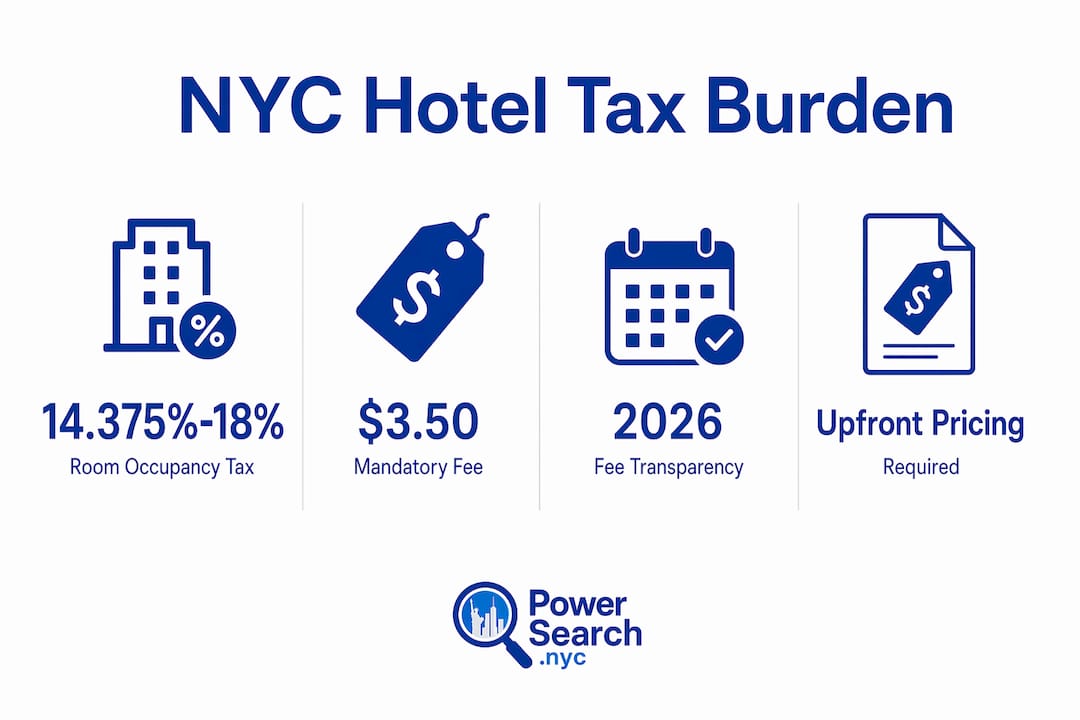
| Charge component | Approximate rate |
|---|---|
| NYC hotel room occupancy tax | ~14.375%–18% |
| Mandatory per-night fee | ~$3.50 flat |
| Total tax impact on $300 room | ~$43–$57 added cost |
These taxes apply to the room rate portion of a bundled charge. If your hotel packages breakfast into the room rate, the tax calculation gets more complicated. The meal portion should be separated before tax is applied, which is why itemization matters at the accounting level, not just for compliance.
Starting february 21, 2026, NYC law requires hotels to display total pricing upfront, including all mandatory fees, and to disclose credit card hold policies to guests. This law directly affects expense reporting because travelers now have a legal right to see the full cost before booking. Finance teams can use this to set more accurate per-trip budgets and avoid reimbursement disputes caused by surprise fees.
Pro Tip: When you check your hotel folio, compare the tax line to the expected 14.375%–18% range. If the number looks off, ask the front desk for a breakdown before you check out. Catching a billing error at the hotel is far easier than disputing it after the fact.
What are the best practices for itemizing NYC hotel bills in expense management systems?
Itemizing a hotel bill correctly is where most expense reports either pass or fail. The goal is to break every charge on your folio into its own line item within your expense management system, assigned to the right date and GL code.
Follow this process for a clean submission:
- Collect the full folio at checkout. Do not rely on the emailed summary. Ask for the detailed version that lists every charge by date.
- Separate room rate from all other charges. Room rate goes to lodging. Meals go to meals. Parking goes to ground transportation. Internet fees go to communications or incidentals, depending on your company’s chart of accounts.
- Enter each night separately. A four-night stay requires four lodging entries, each with its own date and room rate. Lumping them together creates audit risk.
- Use your expense system’s hotel itemization tool. Many enterprise expense platforms include a Hotel Wizard or similar function. Hotel Wizard features let you create individual expense lines for room charges, parking, meals, and internet by date, which matches exactly what auditors want to see.
- Apply NYC taxes to the correct line items. Taxes belong on the lodging line, not spread across meals or incidentals.
Common mistakes that cause rejections:
- Submitting the total hotel charge as a single expense line
- Coding a hotel breakfast to lodging instead of meals
- Forgetting to separate resort fees or destination fees from the room rate
- Entering the full stay as one date instead of nightly entries
Properly splitting bundled charges reduces the risk of audit triggers for misclassified entertainment and meal expenses. Finance teams that enforce this practice consistently see fewer reimbursement delays and cleaner audit trails.
How do corporate travel policies interact with NYC hotel expense reporting requirements?
Corporate travel policies sit on top of IRS rules, not instead of them. Your company’s policy may be stricter than the IRS requires, but it cannot be looser. Understanding both layers is what keeps your expense report compliant and your reimbursement on schedule.
Most corporate NYC travel policies include:
- Hotel rate caps: Many companies set a maximum nightly rate for NYC, often based on GSA per diem rates or a company-defined ceiling. Rates above the cap require pre-approval.
- Pre-trip booking enforcement: Booking outside the approved corporate travel platform can result in out-of-policy charges that are not reimbursable, even if the hotel itself is compliant.
- Submission deadlines: Most companies require expense reports within 30–60 days of travel. Late submissions can result in non-reimbursement.
- Allowable expense categories: Minibar charges, personal calls, and hotel spa services are almost universally excluded. NYC hotel folios often include these charges, so you need to remove them before submission.
- AI-assisted compliance checks: AI-driven expense platforms now automate receipt parsing, GL coding, and pre-trip policy enforcement. This reduces the manual work on your end but also means the system will flag non-compliant submissions instantly.
NYC’s hotel pricing is genuinely different from other U.S. cities. Rates in Midtown Manhattan regularly exceed $400–$500 per night before taxes, and corporate hotel rates in NYC require careful negotiation and advance booking to stay within policy. Finance teams that set NYC-specific rate caps, rather than applying a national average, avoid constant exception requests from travelers.
My take on making NYC hotel expense reporting less painful
I have seen business travelers lose reimbursements not because they spent too much, but because they submitted the wrong document. The folio versus credit card statement issue is the single biggest source of rejected hotel expense reports, and it is entirely avoidable.
The habit that fixes most problems is simple: capture your folio before you leave the hotel. Do not wait until you are building your expense report two weeks later. By then, the hotel’s front desk has changed shifts three times, and getting a corrected document takes days. If you use an expense app that scans receipts, photograph the folio the moment you receive it.
Splitting bundled charges feels tedious, but it protects you. A hotel breakfast coded to lodging looks like an error to an auditor. A resort fee lumped into the room rate creates a tax calculation problem. Taking five extra minutes to separate these charges at submission saves your finance team hours of back-and-forth. Understanding the NYC hotel resort fee rules before your trip also helps you anticipate what will appear on your folio.
The 2026 NYC transparency law is genuinely useful for business travelers. Hotels must now show you the full price upfront, including all fees. Use that number when you request pre-trip approval, not just the base room rate. Your approval amount should match what you will actually pay.
— Mark
Powersearch has the NYC hotel intel you need
Planning a business trip to New York City means dealing with some of the most complex hotel pricing in the country. Powersearch cuts through the noise with guides on NYC hotel fees, tax structures, and booking strategies built specifically for travelers who need accurate information before they book.

Whether you are trying to understand what fees will show up on your folio or looking for NYC hotel and travel resources that cover the full picture, Powersearch has you covered. The site aggregates hotel listings, explains fee structures, and gives you the context to book confidently and report accurately. Check out the guides on NYC hotel pricing and hidden fees to go into your next trip fully prepared.
Key takeaways
Accurate NYC hotel expense reporting requires an itemized folio, correct GL coding, and compliance with both IRS substantiation rules and NYC’s 2026 fee transparency law.
| Point | Details |
|---|---|
| Always get the itemized folio | A credit card statement does not satisfy IRS lodging requirements; the full folio is mandatory. |
| Separate every bundled charge | Room rate, meals, parking, and internet must each have their own expense line and GL code. |
| Account for NYC’s full tax burden | NYC hotel taxes run 14.375%–18% plus a ~$3.50 per-night fee; budget and report accordingly. |
| Use your expense system’s hotel tools | Hotel Wizard and similar features create compliant, date-specific line items that match audit expectations. |
| Know your corporate policy caps | NYC-specific rate caps and pre-trip approval rules sit on top of IRS requirements, not instead of them. |
FAQ
What receipts does the IRS require for NYC hotel expenses?
The IRS requires an itemized receipt for all lodging expenses, regardless of amount. A credit card statement or summary receipt does not qualify.
How much tax should appear on a NYC hotel expense report?
NYC hotel taxes total approximately 14.375%–18% of the room rate, plus a flat mandatory fee of around $3.50 per night. These amounts must appear as separate line items on your expense report.
What happens if I lose my hotel folio?
A Missing Receipt Affidavit and credit card statement may satisfy your company’s internal policy, but the IRS may still disallow the deduction without the original itemized folio. Contact the hotel immediately to request a duplicate.
Do NYC’s 2026 fee transparency laws affect expense reporting?
Yes. Hotels must now display total pricing upfront, including all mandatory fees, starting february 21, 2026. This makes it easier to request accurate pre-trip approval amounts and reduces surprise charges on your folio.
How do I handle bundled hotel charges in an expense report?
Break every bundled charge into separate line items: room rate, meals, internet, parking, and incidentals. Use your expense system’s hotel itemization tool to assign each charge to the correct GL code and date.
No Comments