

NYC Iconic Landmarks: Your Complete Visitor Overview
Disclosure: This post may contain affiliate links. We may earn a commission for purchases made through links in this post, at no cost to you.
New York City’s iconic landmarks are defined as the cultural, historical, and architectural sites that give the city its identity and draw visitors from every corner of the world. This NYC iconic landmarks visitor overview covers the must-see sites every traveler should prioritize, from the Empire State Building to the Statue of Liberty, along with practical tips on timing, costs, and planning. Whether you’re visiting for the first time or returning after years away, these famous NYC sites reward every visit differently. The goal here is simple: help you spend less time guessing and more time actually experiencing the city.
What are the top NYC iconic landmarks every visitor should see?
The best starting point for any visitor is Midtown Manhattan, where the density of must-see NYC landmarks is unmatched anywhere in the world.
- Empire State Building. The 102-story Art Deco tower on 34th Street remains one of the most recognized structures on earth. Its observation decks on the 86th and 102nd floors deliver sweeping views of all five boroughs. You step outside and immediately feel like you’re in a movie.
- Statue of Liberty and Ellis Island. These two sites sit together as a single, powerful experience. The Statue of Liberty represents freedom on a global scale, while Ellis Island tells the story of the millions of immigrants who passed through its doors. The ferry ride across New York Harbor is itself a memorable part of the visit.
- Central Park. The 843-acre green space in the heart of Manhattan is one of the most visited urban parks in the United States. You’ll see locals walking their dogs, tourists rowing on the lake, and street musicians performing near Bethesda Fountain. It’s free, it’s beautiful, and it never gets old.
- Brooklyn Bridge. Walking across the Brooklyn Bridge is one of the best free things you can do in New York City. The 1.3-mile span connects Manhattan and Brooklyn, and the pedestrian walkway offers some of the most photographed views of the Manhattan skyline.
- Rockefeller Center and Times Square. Top of the Rock at Rockefeller Center shows you the Empire State Building, Central Park, and the surrounding skyline all at once. Times Square delivers a full sensory overload experience, especially after dark when the billboards light up the entire block.
These five categories cover the core of any first visit. Each one connects you to a different layer of New York’s story.
How can visitors plan a daily itinerary to efficiently explore NYC landmarks?
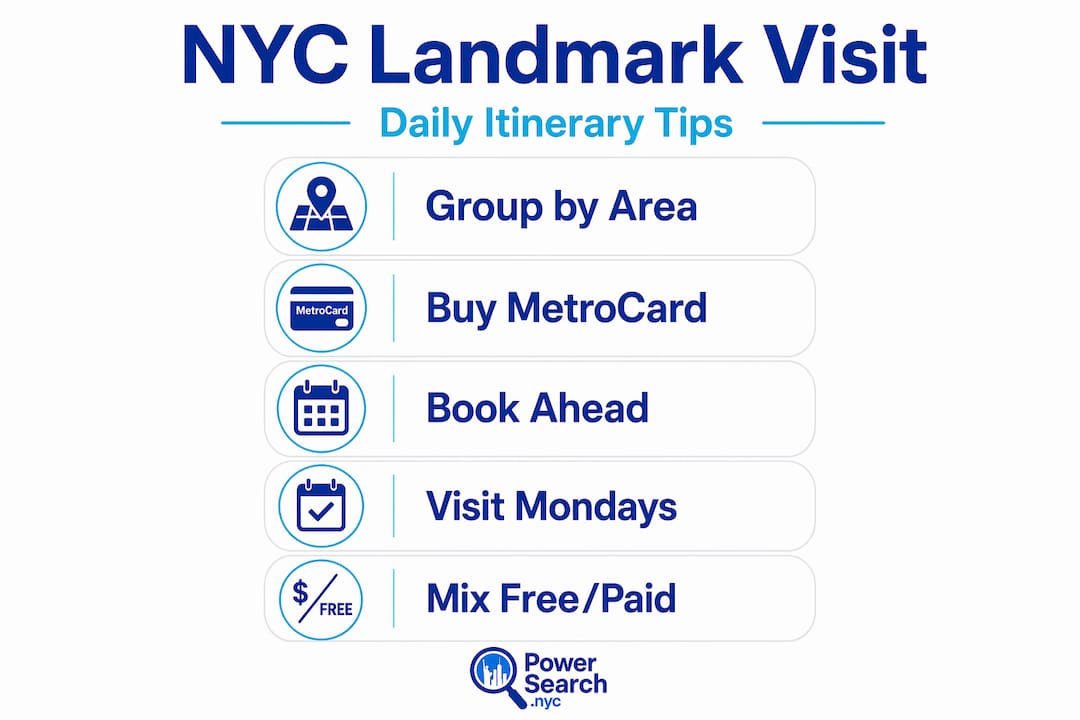
Grouping landmarks by neighborhood is the single most effective way to avoid wasting time on the subway. New York City is large, but its famous sites cluster naturally into two main zones: Midtown Manhattan and Lower Manhattan.

Day 1: Midtown Manhattan. Start at the Empire State Building early in the morning before crowds build. Walk north to Bryant Park, then continue to Rockefeller Center and Times Square. This route covers roughly 15 blocks and is entirely walkable. Midtown also puts you close to the Museum of Modern Art if you want to add a cultural stop.
Day 2: Lower Manhattan. Take the subway to the Financial District and walk the Brooklyn Bridge from the Manhattan side. From there, head to the 9/11 Memorial and Museum, then catch the ferry to the Statue of Liberty and Ellis Island. This is a full day, so start early.
- Start each day before 9:00 AM to beat tour groups at major sites.
- Use the NYC Subway’s A, C, E, and 1 trains to move between Midtown and Lower Manhattan quickly.
- Mix one paid attraction with one free attraction each day to keep costs manageable.
- Build in at least one unscheduled hour per day for spontaneous detours.
- Check each attraction’s website the night before for any closures or special events.
Monday generally sees lower crowds in Midtown Manhattan compared to weekends, making it the best day to visit Times Square and Top of the Rock without fighting through large tour groups.
Pro Tip: Buy your subway MetroCard or OMNY card at the airport or a convenience store before you head to your first landmark. It saves you the scramble of figuring out transit while you’re already tired from traveling.
What are the costs and ticketing options for NYC landmarks?
Knowing what things cost before you arrive removes a lot of stress from the trip. The good news is that some of New York’s best experiences are completely free.
Free landmarks: Central Park, The High Line, Times Square, the Brooklyn Bridge walkway, and the Staten Island Ferry (which offers views of the Statue of Liberty at no charge) all cost nothing to visit. These sites alone can fill two full days.
Paid landmarks: The Met charges $30 per adult as of april 2026. Observation decks like the Empire State Building and SUMMIT One Vanderbilt typically run $40–$45 per person. The Statue of Liberty ferry with monument access costs around $25–$30 per adult depending on the package.
Bundled savings: CityPASS offers up to 42% savings on five top attractions compared to buying individual tickets. That kind of saving adds up fast when you’re visiting multiple paid sites in a single trip. Beyond the money, bundled tickets reduce planning friction by combining access and timing logistics into one purchase. You can also check Powersearch’s guide to NYC travel discount cards for a full breakdown of which passes offer the best value for different itinerary types.
| Landmark | Admission | Notes |
|---|---|---|
| Central Park | Free | Open daily, all hours |
| The High Line | Free | Open daily, seasonal hours |
| The Met | $30 per adult | Suggested donation model |
| Empire State Building | ~$44 per adult | Advance booking recommended |
| Statue of Liberty (with monument) | ~$25–$30 per adult | Ferry included |
| CityPASS (5 attractions) | ~$142 per adult | Up to 42% off individual prices |
Pro Tip: Book observation deck tickets at least 3–5 days in advance, especially in summer and around holidays. Prime evening slots sell out fast, and the sunset view from the 86th floor is worth planning ahead for.
What are some newer or less obvious landmarks worth visiting?
New York keeps adding to its list of top tourist spots, and a few recent additions genuinely deserve a place on your itinerary.
- Little Island. Little Island opened in 2021 as a floating park on the Hudson River at Pier 55 in the Meatpacking District. The park sits on tulip-shaped concrete pillars and offers gardens, performance spaces, and views of the Hudson. It’s free to enter and feels completely unlike anything else in the city.
- The Edge at Hudson Yards. The Edge observation deck features a 65-foot cantilevered glass platform 1,100 feet above Manhattan’s west side. The glass floor gives you a straight-down view of the streets below. It’s genuinely thrilling and offers a different angle on the skyline than the Midtown decks.
- Stonewall National Monument. Located in Greenwich Village, Stonewall is the first national monument dedicated to LGBTQ history in the United States. The site marks the location of the 1969 Stonewall Inn uprising, a pivotal moment in the civil rights movement. It’s free to visit and carries real historical weight.
- The Met with a focused plan. The Metropolitan Museum of Art covers over two million square feet. Focusing on specific highlights like the Temple of Dendur helps you avoid fatigue and actually absorb what you’re seeing. Pick two or three wings and go deep rather than trying to see everything.
These sites add texture to a trip that might otherwise stick only to the greatest hits. They also tend to be less crowded, which makes the experience more personal.
How do you get the most out of visiting NYC landmarks?
The biggest mistake most visitors make is trying to do too much in a single day. Packing six or seven paid attractions into one day leaves you exhausted and unable to enjoy any of them fully.
Experienced travelers allocate 2–3 hours for major museums like The Met for the best experience. That’s enough time to see the highlights without hitting a wall. Apply the same logic to observation decks: go up, take your photos, sit with the view for a few minutes, and let it sink in before you move on.
Advance booking is critical for observation decks, especially during peak seasons like summer and the winter holidays. The Empire State Building and SUMMIT One Vanderbilt both sell out their best time slots days in advance. Booking ahead also lets you plan your day around a fixed schedule rather than waiting in unpredictable lines.
For photo opportunities, the less obvious angles often produce better results. The view of the Brooklyn Bridge from DUMBO in Brooklyn is more dramatic than the view from the bridge itself. The Rockefeller Center view includes the Empire State Building in the frame, which you can’t get from the Empire State Building’s own deck.
Pro Tip: Landmarks connect you to NYC’s culture and history in ways that photos alone can’t capture. Put your phone down for at least five minutes at each site and just look around. You’ll remember those moments longer than any picture.
Key Takeaways
Visiting NYC’s iconic landmarks rewards travelers who plan ahead, mix free and paid sites, and pace themselves across multiple days rather than cramming everything into one.
| Point | Details |
|---|---|
| Start with Midtown and Lower Manhattan | Group landmarks by neighborhood to cut transit time and maximize your day. |
| Mix free and paid attractions | Central Park, The High Line, and Brooklyn Bridge are free; balance them with paid sites to control costs. |
| Use CityPASS for paid sites | Bundled passes save up to 42% and reduce the hassle of booking each attraction separately. |
| Book observation decks in advance | Prime time slots at the Empire State Building and SUMMIT One Vanderbilt sell out days ahead. |
| Add newer landmarks to your list | Little Island, The Edge, and Stonewall National Monument add depth beyond the standard itinerary. |
What I’ve learned from visiting NYC landmarks over and over
The first time I visited New York, I made the classic mistake: I tried to see everything in three days. I hit the Empire State Building, the Statue of Liberty, Central Park, the Brooklyn Bridge, and The Met all in a row. By day two, I was running on coffee and stubbornness, and I barely remember half of it.
What actually works is treating each landmark as its own experience rather than a checkbox. The Brooklyn Bridge walk is not just a transit moment between Manhattan and Brooklyn. It’s a 30-minute experience where the skyline shifts around you as you cross. If you rush it, you miss the whole point.
The newer sites like Little Island and The Edge are worth your time precisely because they’re not on every tourist’s radar yet. You get the views and the experience without the shoulder-to-shoulder crowds. That changes how you feel about a place.
My honest recommendation: plan your top three or four must-see sites, book them in advance, and leave the rest of your days open for wandering. Some of the best NYC moments happen when you turn down a street you didn’t plan to walk down. The city rewards curiosity more than it rewards a tight schedule.
— Mark
Plan your NYC visit with Powersearch
Powersearch makes it easier to put your trip together without the back-and-forth of checking a dozen different sites.

You can search hotels and attractions in NYC by neighborhood, price point, and proximity to the landmarks on your list. If you’re looking for the best rates near Times Square or want to compare options close to the Financial District, Powersearch has the filters to get you there fast. The things-to-do search lets you browse tours, experiences, and activities alongside your hotel options so everything lines up before you arrive. For travelers who want to cut costs on multiple attractions, the discount card guide breaks down exactly which passes are worth buying for your specific itinerary.
FAQ
What are the most iconic landmarks in NYC?
The Empire State Building, Statue of Liberty, Central Park, Brooklyn Bridge, and Rockefeller Center are the most recognized landmarks in New York City. Each one represents a different aspect of the city’s history, culture, and architecture.
Which NYC landmarks are free to visit?
Central Park, The High Line, Times Square, the Brooklyn Bridge walkway, and the Stonewall National Monument are all free to visit. The Staten Island Ferry also offers views of the Statue of Liberty at no cost.
Is CityPASS worth buying for NYC landmarks?
CityPASS offers up to 42% savings on five top attractions compared to buying individual tickets, making it a strong value for visitors planning to visit multiple paid sites. It also simplifies booking by bundling access into a single purchase.
When is the best time to visit crowded NYC landmarks?
Monday generally sees lower tourist density at Midtown landmarks like Times Square and Top of the Rock compared to weekends. Arriving before 9:00 AM at any major site also reduces wait times significantly.
How far in advance should I book NYC observation decks?
Book observation decks like the Empire State Building and SUMMIT One Vanderbilt at least 3–5 days ahead, and further in advance during summer or holiday periods. Prime evening time slots sell out quickly and are not always available at the door.
No Comments