

How NYC Family Hotel Pricing Works in 2026
Disclosure: This post may contain affiliate links. We may earn a commission for purchases made through links in this post, at no cost to you.
Planning a family trip to New York City is exciting right up until you start looking at hotel prices. Suddenly, how nyc family hotel pricing works feels like a mystery with no clean answer. Rates shift daily, advertised prices don’t always match checkout totals, and figuring out whether you need one room or two becomes its own project. The good news? Two major changes in 2026 have made pricing significantly more transparent and predictable for families. This guide breaks down exactly what drives those numbers, what fees to watch for, and how to book smarter.
Table of Contents
- Key takeaways
- How NYC hotel pricing structures work
- What the 2026 NYC junk fee ban means for families
- Family-specific pricing factors to understand
- Practical tips for finding affordable, transparent NYC hotels
- My take on navigating this as a family
- Find your family’s perfect NYC hotel with Powersearch
- FAQ
Key takeaways
| Point | Details |
|---|---|
| Prices change constantly | Hotels reprice rooms multiple times daily using automated systems tied to demand and booking speed. |
| Hidden fees are now banned | NYC’s 2026 law requires all mandatory fees to be included in the advertised price upfront. |
| Labor costs affect your rate | A May 2026 wage deal for hotel housekeepers will push moderate rate increases through 2027. |
| Family room types vary widely | Suites, connecting rooms, and family rooms are priced differently, and occupancy policies differ by hotel. |
| Book early and off-peak | Booking weeks ahead and targeting midweek or winter dates gives families the best base rates. |
How NYC hotel pricing structures work
Here is the part most families never get told. Hotel prices in New York City are not set once and left alone. Automated Revenue Management Systems adjust rates multiple times every single day based on incoming reservations, competitor pricing, local events, and how fast a hotel is filling up. This is called booking velocity. When a hotel is filling quickly, prices go up automatically. When rooms are sitting empty, prices drop to attract bookings.
Hotel pricing is no longer static or seasonal but driven by real-time data including demand signals, competitor moves, and event calendars. That rate you checked on Monday morning may be completely different by Tuesday afternoon. For families comparing options across multiple days, this can make budgeting feel chaotic.
There is also a newer layer of complexity. New York’s Algorithmic Pricing Disclosure Act requires businesses that use personal data to set prices to clearly disclose it. Since November 2025, you may see the statement “THIS PRICE WAS SET BY AN ALGORITHM USING YOUR PERSONAL DATA” when booking online. This is not a warning to panic over. It is actually a protection, telling you that the price you see is personalized to your browsing profile.
And then there is the labor cost factor. A May 2026 wage deal set NYC hotel housekeepers’ wages at $61 per hour, up from a previous range of $38 to $48 per hour. Hotels are adjusting their operational costs, and moderate rate increases are expected through 2027. Budget hotels tend to pass those increases directly to guests through higher nightly rates, while luxury properties are more likely to absorb costs or bundle added value.
Here is what you should understand about how hotels segment their pricing:
- Room type: Standard rooms, suites, connecting rooms, and family rooms each carry different base rates.
- Occupancy level: More guests in a room typically means a higher rate, though children are sometimes exempt depending on the hotel’s policy.
- Length of stay: Some hotels offer slight discounts for longer bookings, while others charge a premium for single-night stays.
- Booking channel: Rates on the hotel’s own website sometimes differ from third-party platforms due to commission structures.
Pro Tip: If you are booking for a family of four or more, always check whether the hotel defines children by age cutoff. A 13-year-old may be counted as an adult at some properties, which directly affects the rate you are quoted.
What the 2026 NYC junk fee ban means for families
Before February 2026, many NYC hotels tacked on fees after you had already committed to a booking. Resort fees, destination fees, and hospitality fees would appear at checkout, sometimes adding $30 to $50 per night on top of the advertised price. For a five-night family trip, that could mean an unexpected $250 surprise.

NYC’s February 2026 ban now requires hotels to include all mandatory fees in the advertised price. No more hidden resort or destination charges that show up only at checkout. The city received over 300 consumer complaints about hidden fees in 2025 before the new rule came into force, and the ban is expected to save consumers millions annually.
Here is how this change affects your family’s trip planning step by step:
- The advertised price is the real price. What you see listed must now include every mandatory charge. No mental math required at checkout.
- Comparison shopping is more reliable. When every hotel shows its full price upfront, you can actually compare apples to apples across neighborhoods and properties.
- Budget planning gets easier. You can set a firm nightly budget and trust that it will hold, which matters a lot when you are managing flights, meals, and attraction tickets.
- Credit card holds still apply. Hotels may still place a hold on your card for incidentals at check-in. This is temporary and released after checkout, but it is worth knowing in advance so it does not catch you off guard.
- Optional charges are still separate. Parking, spa access, and resort amenity packages are not mandatory, so they are not covered by the ban. These are clearly labeled as add-ons.
Transparency laws in New York aim to protect consumers from opaque pricing by requiring clear disclosures when personal data influences prices. Combined with the junk fee ban, families booking NYC hotels in 2026 have more protection than ever before.
Family-specific pricing factors to understand
Not all hotel pricing is created equal when you add children to the equation. Understanding the specific ways NYC hotels price for families helps you avoid paying more than you should and finding the right room configuration from the start.
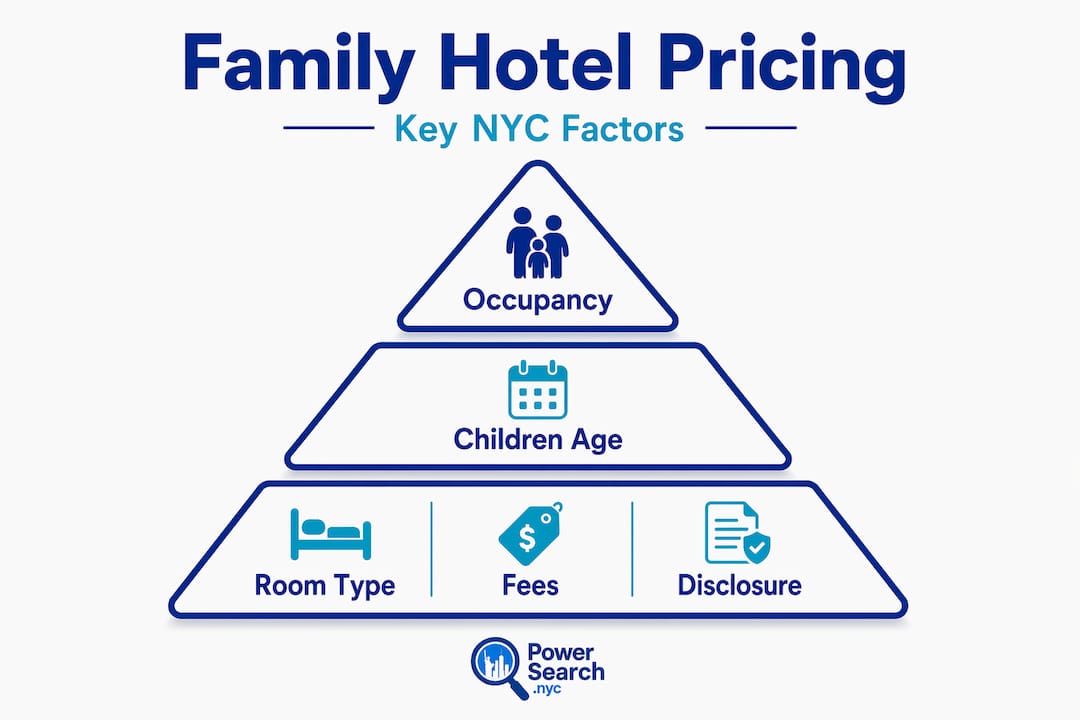
Choosing between a suite or connecting rooms versus a single standard room is one of the biggest decisions that affects your total cost. Many families assume a suite is always more expensive, but connecting rooms sometimes cost less per night when you split the total across the party.
Here is what shapes family-specific pricing the most:
- Children’s age cutoffs: Hotels define “child” differently. Some offer free stays for kids under 12. Others count anyone over 5 as an adult for occupancy purposes. Always check the policy before booking.
- Maximum occupancy rules: NYC fire codes set occupancy limits per room. A family of five may automatically be steered into a more expensive configuration even if they would fit comfortably in a standard room elsewhere.
- Booking platform versus direct booking: When you search “2 adults and 2 children,” some platforms adjust the displayed rate based on occupancy. Searching as “4 adults” on the same platform can sometimes return different rates for the same room.
- Timing your search: Average NYC hotel room prices hit $417 in September 2024. Searching during the same high-demand period with children in tow limits your room options and drives up costs across family-suitable configurations.
If you are traveling with a larger group, a guide on booking connecting rooms in NYC can save you a lot of time and prevent you from overpaying for the wrong room type.
Pro Tip: Try searching your dates with different occupancy combinations on the same platform. You may find that changing the number of “adults” versus children produces meaningfully different rate results for the exact same room.
Practical tips for finding affordable, transparent NYC hotels
Good news: knowing how the system works puts you in a strong position to use it to your advantage. These strategies are specific to families and grounded in how NYC hotel pricing actually operates today.
Start with timing. Hotels reprice rooms based on booking velocity, meaning the faster a hotel fills up, the higher the price climbs. Booking four to six weeks ahead lets you secure rates before demand spikes. Waiting until the week before arrival, especially during school holidays or summer, almost always means paying a premium.
Off-peak timing makes a real difference too. Winter months in NYC, particularly January and February, offer the lowest base rates of the year. Midweek stays from Sunday through Thursday are consistently cheaper than Friday and Saturday nights. If your family has any flexibility around dates, even shifting arrival by one day can save you meaningfully.
When you compare prices across platforms, keep these points in mind:
- Check the hotel’s official website alongside aggregator platforms. Hotels sometimes offer perks like free breakfast or flexible cancellation on direct bookings that offset a slightly higher listed rate.
- Incognito mode mainly resets geographic data rather than your browsing history, meaning it affects pricing tiers tied to your location rather than your search history. It is worth trying but is not a magic price-drop button.
- After the 2026 fee ban, verify that the listed price includes all mandatory charges. Legitimate NYC hotels must comply, but always confirm during the booking flow.
- For families on a tighter budget, exploring affordable NYC hotel options specifically designed for families can reveal good value that standard searches miss.
Pro Tip: Search your target dates, then check rates for the days one week earlier and one week later. You will often spot a window where demand drops and prices follow, sometimes by $50 to $100 per night for the same property.
My take on navigating this as a family
I have spent years watching families walk into NYC hotel bookings unprepared and walk out frustrated. The pricing feels personal when it is actually mechanical. That is the part most people miss.
What I have seen confuse families most is not the price itself. It is the gap between what they expected to pay and what actually appeared at checkout. That gap used to be filled with junk fees. Now that NYC has banned them, the playing field is genuinely more honest. But the dynamic pricing piece is still very much alive, and most families do not realize their rate changed three times while they were deciding.
The labor cost increases are real and are going to have an ongoing effect on base rates. I would not panic about it, but I would factor in that budget properties are less able to absorb those costs quietly. If you are comparing a budget option to a mid-range one and the price difference feels smaller than it used to, that is likely why.
What most guides skip is this: the families who book well are the ones who treat hotel pricing like they treat airfare. They check early, they check often, they understand that waiting has a cost. The 2026 transparency rules are a genuine gift. Use them. Compare full prices, not teasers.
— Mark
Find your family’s perfect NYC hotel with Powersearch

Powersearch makes it easy for families to cut through the confusion and find NYC hotels that actually fit. The search tool at Powersearch NYC hotels lets you filter by room type, family-friendly amenities, neighborhood, and price, all with fully inclusive pricing that reflects the 2026 fee regulations. You will see the real cost upfront, not a number that grows at checkout.
Whether you are looking for a budget-friendly base to explore the city or a suite with space for everyone to breathe, Powersearch shows you options that match what your family actually needs. Start your search early, use the filters, and book with confidence knowing the price you see is the price you pay.
FAQ
What are the main hidden fees NYC families used to face?
Before the 2026 ban, the most common charges were resort fees, destination fees, and hospitality fees, which could add $30 to $50 per night on top of the advertised room rate.
How does NYC hotel pricing change throughout the day?
Hotels use automated systems that reprice rooms multiple times daily based on current demand and how quickly rooms are booking. A rate you check in the morning may be higher by the afternoon.
Are hidden hotel fees still legal in NYC in 2026?
No. As of February 21, 2026, NYC requires all mandatory fees to be included in the advertised price. Hotels that break this rule face enforcement action from the city.
Why do family hotel rates differ when I change the number of children?
Hotels price rooms by occupancy and apply different rules for children depending on age. Changing how many children or adults you enter into a search can trigger different room configurations and rates, especially when occupancy limits come into play.
When is the cheapest time to book a family hotel in NYC?
Midweek stays and winter months, particularly January and February, consistently offer the lowest NYC hotel rates. Booking four to six weeks in advance also helps you lock in lower prices before demand increases.
No Comments