

NYC Family Hotel Review Criteria Explained for Parents
Disclosure: This post may contain affiliate links. We may earn a commission for purchases made through links in this post, at no cost to you.
Planning a family trip to NYC is exciting, but picking the right hotel can feel genuinely overwhelming. Every property calls itself “family-friendly,” yet that label covers everything from a hotel with a vending machine on every floor to one with a full kids’ club and connecting suites. Getting nyc family hotel review criteria explained in plain terms before you book saves you from arriving with two tired kids to find a sofa bed that barely fits one of them. This guide breaks down exactly what to look at, what to ignore, and how to read reviews like a pro.
Table of Contents
- Key takeaways
- NYC neighborhoods for family stays
- Room features that actually matter for families
- Evaluating amenities beyond the marketing photos
- How to read online family hotel reviews
- What I’ve learned families almost always overlook
- Find the right NYC family hotel faster with Powersearch
- FAQ
Key takeaways
| Point | Details |
|---|---|
| Location shapes your whole trip | Choose your NYC neighborhood based on your family’s priorities, not just proximity to Times Square. |
| Room layout beats star rating | Verify bed configurations, adjoining rooms, and soundproofing before committing to any booking. |
| Amenities need specifics | Look for exact kids’ club hours and age ranges, not just a photo of a playroom. |
| Reviews require critical reading | Trust recurring, specific themes in reviews far more than perfect scores or generic praise. |
| Define your priorities first | A weighted checklist built around your family’s needs cuts through marketing noise every time. |
NYC neighborhoods for family stays
Where you stay in New York City shapes almost everything about your trip. It affects how far you walk with a stroller, how loud the nights are, how quickly you reach a park when someone melts down, and how easy it is to hop on the subway with a loaded diaper bag.
Experts recommend families evaluate neighborhoods based on specific trip goals to balance convenience and family comfort. Here is a quick breakdown of how the main options compare:
- Midtown (including Times Square area): Perfect if you want Broadway, the Rockefeller Center, and major museums all within walking distance. The trade-off is noise and crowds. At night, Times Square is a full sensory overload experience. If you have young kids who go to bed early, thin hotel walls in this zone will test your patience. That said, for first-time families in NYC, the convenience factor is hard to beat.
- Upper West Side: Quieter, greener, and genuinely stroller-friendly. You are steps from Central Park, the American Museum of Natural History, and wide, calmer sidewalks. Locals walk their dogs here in the morning. It feels residential rather than chaotic. For families with younger children or those who need green space daily, this neighborhood delivers.
- SoHo and Tribeca: Upscale, walkable, and increasingly family-oriented. Tribeca in particular has a reputation as one of the more family-friendly downtown neighborhoods. Hotels here tend to be boutique and pricier, but you get cobblestone streets, excellent dining, and proximity to the Brooklyn Bridge. Subway access is solid, though the area feels less “theme park” than Midtown.
Defining priorities early, whether that is subway access, theater proximity, or green space, prevents real friction once you arrive. A family with a 10-year-old Broadway fan has completely different needs than one traveling with a toddler and a baby.
Pro Tip: Before you search for hotels, write down your top three non-negotiables as a family. If one parent needs walkability and another needs quiet evenings, you need to agree on what you are actually optimizing for before comparing properties.
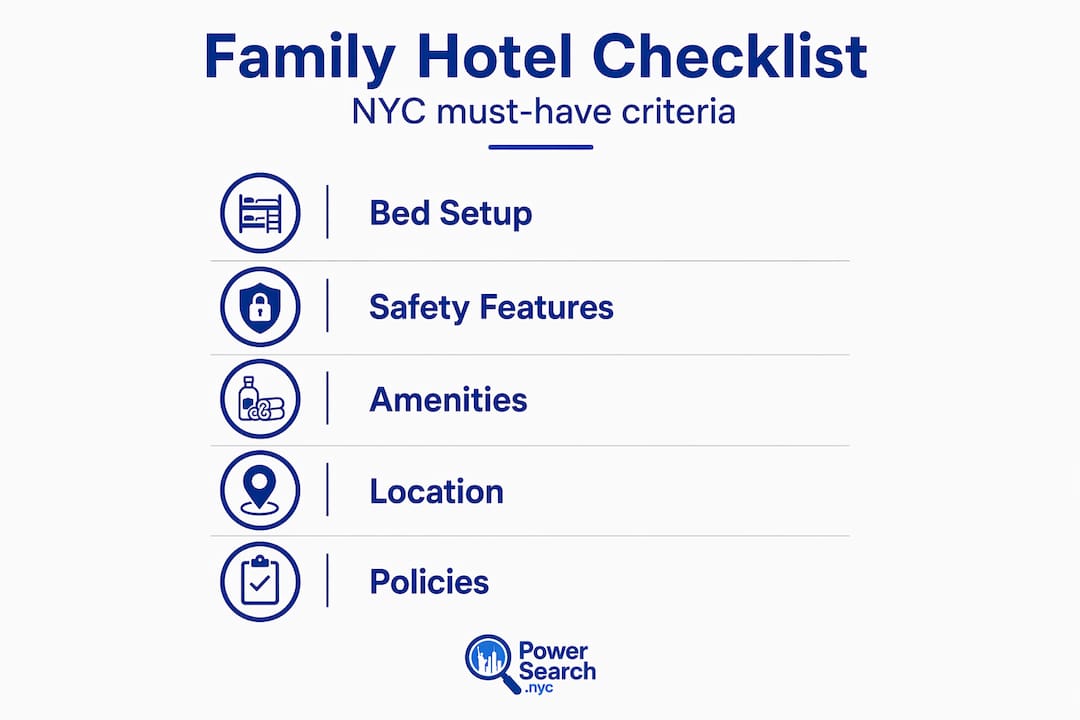
For a deeper look at NYC neighborhood comparisons, Powersearch has a full breakdown to help you match your family’s vibe to the right area.
Room features that actually matter for families
This is where most families get burned. They book based on a photo of a bright, well-lit room and assume it will work. Then they show up and discover that “sleeps four” means two adults in a king bed and two kids sharing a narrow sofa bed that sags in the middle.
Star ratings are less relevant than room layouts, safety features, and family-oriented services. Here is a practical comparison of what to look for versus what to question:
| Room feature | What to look for | What to question |
|---|---|---|
| Bed configuration | Adjoining rooms, bunk beds, or separate sleeping areas | “Sleeps 4” with one king and a pullout sofa |
| Bathroom count | Two bathrooms for families with older kids or teens | Single bathroom in a room with four guests |
| Soundproofing | Thick walls, interior-facing rooms, higher floors | Street-facing budget rooms in Midtown |
| Kitchen access | Kitchenette or mini-fridge for snacks and formula | No refrigeration options in the room |
| Safety features | Child locks, covered outlets, stroller storage | Open floor plans with sharp furniture edges |
Not all family rooms are created equal. Verifying floor plans and bed configurations before booking is the single most practical thing you can do. Many hotels post generic floorplans online but will send exact layouts on request.
Sleeping arrangements matter differently depending on your kids’ ages. A family with a toddler and an infant needs a crib plus a safe sleeping space separate from the adults. A family with two teens needs privacy and ideally a second bathroom. Do not assume the hotel’s definition of “family room” matches your actual situation.
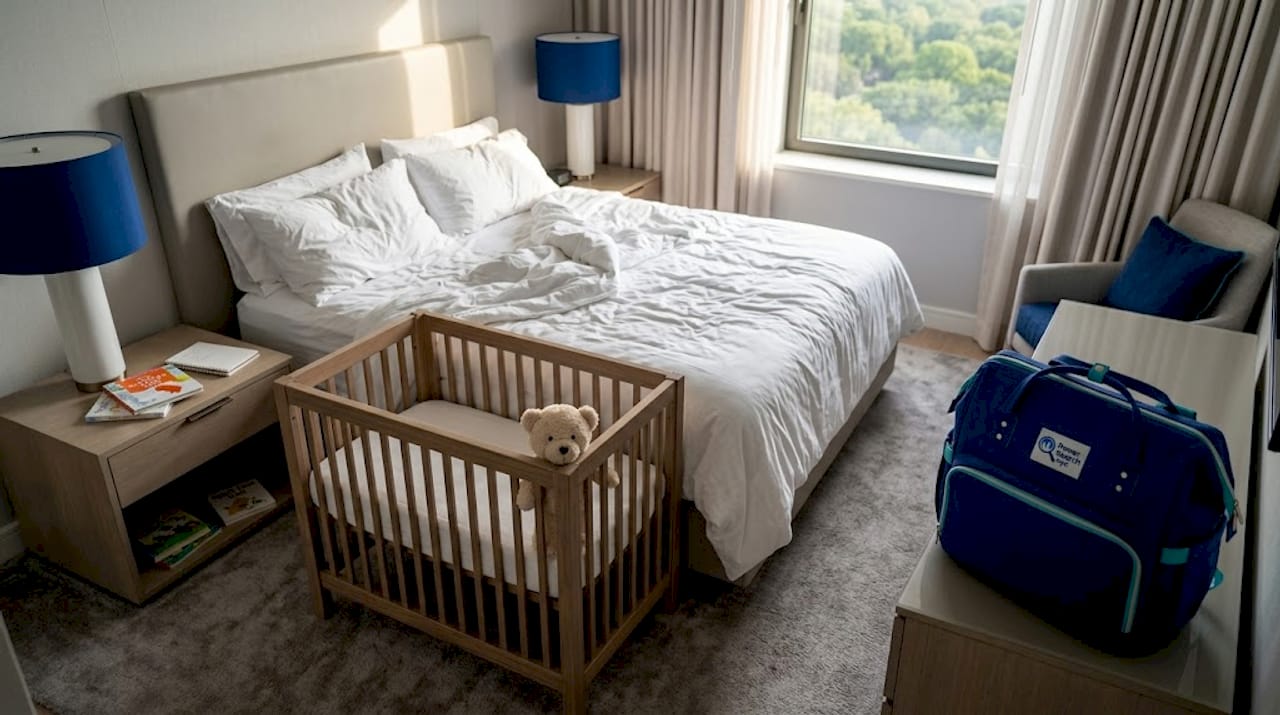
Pro Tip: Call the hotel directly and ask for the exact square footage of the room and whether adjoining rooms can be guaranteed at booking, not just requested. Hotels often hold back connecting rooms until check-in, and by then they may be gone.
Inquiring about hidden policies like rollaway bed restrictions and exact occupancy limits for children can save you from an unpleasant surprise. Some hotels charge per child regardless of whether they share a bed. Others cap occupancy in ways that make their “family room” functionally useless for a family of five.
Evaluating amenities beyond the marketing photos
A photo of a pool on a hotel website tells you almost nothing. What you actually need to know is whether that pool has dedicated kids’ hours, what the depth is, whether there is a lifeguard on duty, and how crowded it gets on a Saturday morning in July.
Experts advise assessing specific amenity details rather than relying on glossy marketing to identify genuinely family-friendly hotels. Here is what deserves your attention:
- Kids’ club specifics: What are the operating hours? What age groups are actually served? A kids’ club that runs from 10am to 5pm does not help you if your family is out sightseeing during those hours. Ask whether programming is drop-off or parent-accompanied.
- Dining flexibility: Does the restaurant have a kids’ menu, or do they just hand children a plain pasta option? Can they accommodate allergies? Is breakfast included, and does it work for picky eaters? These details matter enormously over a multi-day stay.
- Baby gear rental and supplies: Asking about baby gear availability upfront, including cribs, strollers, highchairs, and bottle sterilizers, reduces stress and eliminates the need to pack half your nursery on the plane.
- Play areas and recreation: A dedicated play area for children under five looks very different from a game room targeting tweens. Confirm which age groups the facilities genuinely serve.
- Childcare and babysitting: Some NYC hotels coordinate with vetted babysitting services so you can squeeze in a dinner alone. Not every hotel advertises this, but many will arrange it if you ask at booking.
The best approach here is simply to call and ask direct questions. If a hotel’s front desk cannot answer basic questions about kids’ club hours or crib availability without putting you on hold for five minutes, that itself tells you something about their readiness to serve families.
How to read online family hotel reviews
Online reviews are your best research tool, but only if you know how to filter the noise. Most people scroll to the rating, skim two or three glowing comments, and book. That approach works fine for a solo work trip. It does not work for a family of four counting on specific room features and amenities.
Here is a practical process for reading family hotel reviews with real confidence:
- Sort by travelers with families. Most major booking platforms let you filter reviews by traveler type. Read at least fifteen to twenty family reviews, not the general pool. A hotel can be fantastic for business travelers and genuinely miserable for parents with toddlers.
- Look for recurring themes over individual ratings. Consistent themes across multiple reviews tell you far more than a single five-star write-up. If six reviews in a row mention thin walls, take that seriously. If ten reviews mention how helpful the concierge was with stroller storage, that is real.
- Spot the red flags in fake or inflated reviews. Marketing-heavy language in reviews, phrases like “world-class service” or “exceeded every expectation,” with no specific details is a signal to be cautious. Authentic reviews name staff members, describe specific rooms, and mention both good and imperfect moments.
- Check reviewer profiles for authenticity. A reviewer who has posted forty reviews over three years and mentions their kids in multiple posts is a credible source. A brand-new account with one glowing review is not.
- Match the reviewer’s family situation to yours. A review from a couple with a newborn is almost irrelevant if your kids are nine and twelve. Look for reviewers who mention ages and needs similar to your family’s.
Pro Tip: Search for reviews that mention specific room numbers or floor levels. Guests who share that level of detail are almost always writing from genuine experience, and their observations about noise, views, and room size are far more reliable.
Using a weighted scoring approach tailored to your family’s specific criteria reduces emotional bias when comparing hotels. Build a simple spreadsheet with your top priorities, location, room size, amenities, and noise level, then score each shortlisted hotel based on what you find in reviews. It sounds like extra work, but it takes about twenty minutes and prevents a $400-per-night mistake.
What I’ve learned families almost always overlook
I’ve spent years looking at how families approach NYC hotel booking, and the most consistent mistake I see is choosing based on what a hotel looks like rather than how it functions when you are actually living in it for four days with children.
Operational logistics should outweigh visual appeal when choosing a family hotel. I’ve seen families book stunning boutique properties in SoHo, only to discover the elevator fits one stroller with difficulty, there is no luggage storage on arrival day, and the restaurant stops serving at 9pm. None of that shows up in the photos.
What I’ve found actually works is getting specific before you search. Write down your family’s real requirements: do you need a crib or a rollaway? Do your kids need separate sleeping space from you? Is quiet after 8pm critical? Then treat those requirements as filters, not preferences.
Defining your family’s key priorities early reduces friction and genuinely improves satisfaction. That sounds obvious, but most families skip this step and then argue about the hotel choice after booking.
My honest take on criteria for family hotel reviews: a hotel with three and a half stars and adjoining rooms, a working kitchenette, and easy park access will almost always outperform a five-star property where your kids are sleeping six feet from your bed in a “deluxe family room.” Star ratings measure luxury amenities, not family suitability. Treat them accordingly.
— Mark
Find the right NYC family hotel faster with Powersearch
Now that you know what to look for, the next step is putting that criteria to work in an actual search.

Powersearch was built for exactly this kind of decision. You can use the Powersearch hotel search tool to filter NYC properties by neighborhood, amenities, and price point so you are comparing options that actually fit your family’s needs, not just whatever the algorithm surfaces first. For families focused on room configurations and suite options, the NYC family suite booking guide walks through the specific room types that work best for different family sizes and ages. And if you want to plan activities around your hotel choice, the NYC things to do search makes it easy to see what is close by before you commit to a location. Stop guessing and start comparing with tools built for the way families actually plan trips.
FAQ
What does “family-friendly” actually mean for NYC hotels?
It varies widely. A genuinely family-friendly hotel offers specific amenities like cribs, kids’ menus, and family room layouts, not just a marketing label. Always check the details before booking.
How do I pick the best NYC neighborhood for my family?
It depends on your priorities. Midtown works well for sightseeing access, the Upper West Side suits younger children with its park proximity, and Tribeca offers a quieter, walkable downtown feel.
Are star ratings a reliable guide for family hotel choice?
Not really. Star ratings reflect luxury, not family suitability. A three-star property with connecting rooms and a kitchenette often serves families far better than a five-star hotel with small standard rooms.
What should I ask a hotel before booking for my family?
Ask about exact bed configurations, crib availability, rollaway bed policies, occupancy limits for children, and whether connecting rooms can be guaranteed at booking rather than just requested.
How can I tell if a family hotel review is trustworthy?
Look for specific details and recurring themes across multiple reviews. Reviewers who mention room numbers, staff names, and concrete experiences are far more reliable than those using generic praise.
No Comments