

Why Book NYC Hotels Midweek: Save more, stress less
Disclosure: This post may contain affiliate links. We may earn a commission for purchases made through links in this post, at no cost to you.
Most travelers assume the weekend is the right time to visit New York City. More time off, more fun, right? The reality is that choosing to book NYC hotel midweek is one of the smartest moves you can make as a budget-conscious traveler. Rates drop, crowds thin out, and the city actually becomes easier to enjoy. This guide breaks down exactly why midweek is better, how much you can realistically save, and how to time your booking for maximum value.
NYC Midweek Hotel Guide: Savings, Crowds & Booking Tips
- The dynamics of NYC hotel pricing: What drives midweek savings
- Why midweek stays mean fewer crowds and a better NYC experience
- Timing your midweek stay: Booking strategies to maximize savings and flexibility
- Comparing midweek vs. weekend hotel stays in NYC: A side-by-side overview
- Planning your midweek NYC trip: Practical tips to maximize value and experience
- Why booking NYC hotels midweek is a traveler’s secret weapon
- Discover exceptional midweek hotel deals with PowerSearch NYC
- Frequently asked questions
Key Takeaways
| Point | Details |
|---|---|
| Midweek hotel rates | New York City hotels are significantly cheaper midweek, with 30-50% lower prices compared to weekends. |
| Better visitor experience | Midweek stays mean fewer crowds, easier access to attractions, and improved service in restaurants and hotels. |
| Smart booking timing | Book six to eight weeks early but monitor last-minute cancellations to find the best midweek rates. |
| Avoid event clashes | Checking NYC event calendars helps travelers avoid unexpected price surges and crowded days midweek. |
| Maximize savings | Extending midweek stays by multiple nights often results in additional discounts and better deals. |
The dynamics of NYC hotel pricing: What drives midweek savings
Understanding why NYC hotel prices behave the way they do is the first step to booking smarter. Hotels are businesses that live and die by occupancy rates. When demand drops, prices follow. And midweek in New York City is where demand consistently falls off a cliff compared to weekends.
NYC hotel rates peaked at an average daily rate of $417 per night in September 2024, but midweek stays during the January to March low season average $200 to $450 for 3-star properties, which is 30 to 50% below peak weekend rates. That is not a small discount. On a three-night stay, you could easily save $300 or more just by shifting your arrival from Friday to Monday.
Part of what makes this possible is that NYC hotels serve two very different audiences: business travelers who fill rooms Monday through Thursday, and leisure travelers who flood in on weekends. When business demand softens and leisure travelers have not yet arrived, hotels face a gap they need to fill. They fill it by lowering prices. Midweek Sheraton Times Square rooms were listed at $219 per night as of May 2026, well under the $300 threshold despite the city’s average rates sitting above $400.
Here is a quick look at how midweek pricing stacks up across property types:
| Property type | Average weekend rate | Average midweek rate | Estimated savings |
|---|---|---|---|
| Budget (1-2 star) | $180 to $250 | $120 to $180 | 25 to 35% |
| Mid-range (3 star) | $300 to $450 | $200 to $320 | 30 to 40% |
| Upscale (4 star) | $450 to $650 | $280 to $450 | 30 to 50% |
| Luxury (5 star) | $700+ | $450 to $600 | 20 to 35% |
Key reasons hotels drop midweek prices:
- Lower leisure demand between Monday and Thursday
- Business travel has shifted post-pandemic, reducing midweek corporate bookings
- Hotels use dynamic pricing (rates that change based on real-time demand) to fill empty rooms
- Ancillary revenue from dining, spa, and amenities increases when more guests are in the building
Pro Tip: Search for affordable Manhattan hotel deals on Tuesday or Wednesday mornings. Hotels often update their pricing algorithms overnight, and Tuesday tends to show the lowest available rates for upcoming weeks.
Why midweek stays mean fewer crowds and a better NYC experience
Saving money is great. But the benefits of a midweek hotel stay in NYC go well beyond your wallet. The city itself changes when the weekend tourist wave recedes. Museums breathe. Restaurants have open tables. The sidewalks in Midtown feel less like a rugby scrum.

Midweek NYC visits avoid the 85% or higher occupancy spikes that hit Midtown hotels on weekends, which directly translates to better service ratios, easier restaurant reservations, and quieter access to major attractions like museums and Broadway shows. When a hotel is running at 65% capacity instead of 95%, the front desk staff has time to actually help you. The housekeeping team is not racing through 40 rooms before noon.
Think about what this means practically. You want to grab brunch at a popular spot in the West Village on a Tuesday? Walk right in. Try that on a Sunday and you are waiting 90 minutes on the sidewalk while a line forms behind you. The Metropolitan Museum of Art on a Wednesday morning feels like a private tour compared to the shoulder-to-shoulder experience on a Saturday afternoon.
Here is what midweek travelers consistently report:
- Faster check-in and more attentive hotel service
- Easier access to popular NYC attractions without timed entry stress
- More availability at top restaurants, including last-minute bookings
- A quieter, more local vibe in neighborhoods like the Lower East Side, Williamsburg, and the West Village
- Less noise and congestion around Times Square and Midtown
Pro Tip: Check out NYC travel tips for off-peak times before you go. Knowing which days specific attractions are least crowded can help you build a daily itinerary that feels effortless rather than exhausting.
Timing your midweek stay: Booking strategies to maximize savings and flexibility
Knowing that midweek is cheaper is one thing. Knowing how to book it to get the best possible rate is where the real savings happen. Timing matters a lot here, and there are a few approaches worth knowing.
Booking 6 to 8 weeks in advance gives you the best shot at availability, and then monitoring rates within 48 to 72 hours of cancellation windows lets you rebook at lower prices if rates drop. Flexible dates can save $50 to $200 on a three-night stay. That flexibility is your biggest asset.
Here is a step-by-step approach to booking your midweek NYC hotel:
- Set your target dates. Aim for Monday to Thursday arrivals to capture the deepest discounts.
- Book early with free cancellation. Lock in a rate 6 to 8 weeks out, choosing a property with a 48 to 72-hour cancellation policy.
- Monitor rates regularly. Check back every few days. Hotel pricing shifts constantly.
- Watch for the Friday price drop. Midweek NYC bookings often drop by Friday as hotels adjust prices to fill remaining rooms, saving travelers 20 to 30%.
- Rebook if you find a better rate. Cancel your original reservation and rebook at the lower price, as long as you are within the free cancellation window.
Additional tactics worth using:
- Check rates on the hotel’s own website alongside third-party platforms. Direct bookings sometimes include perks like free breakfast or early check-in.
- Use incognito mode when searching. Some platforms adjust prices based on your browsing history.
- Consider arriving Sunday night instead of Monday morning. Sunday rates are often lower than Friday and Saturday, and you wake up ready to explore on Monday.
Pro Tip: Use NYC hotel booking strategies to filter by cancellation policy. Prioritizing free cancellation options gives you the flexibility to rebook without losing money if a better rate appears.
Comparing midweek vs. weekend hotel stays in NYC: A side-by-side overview
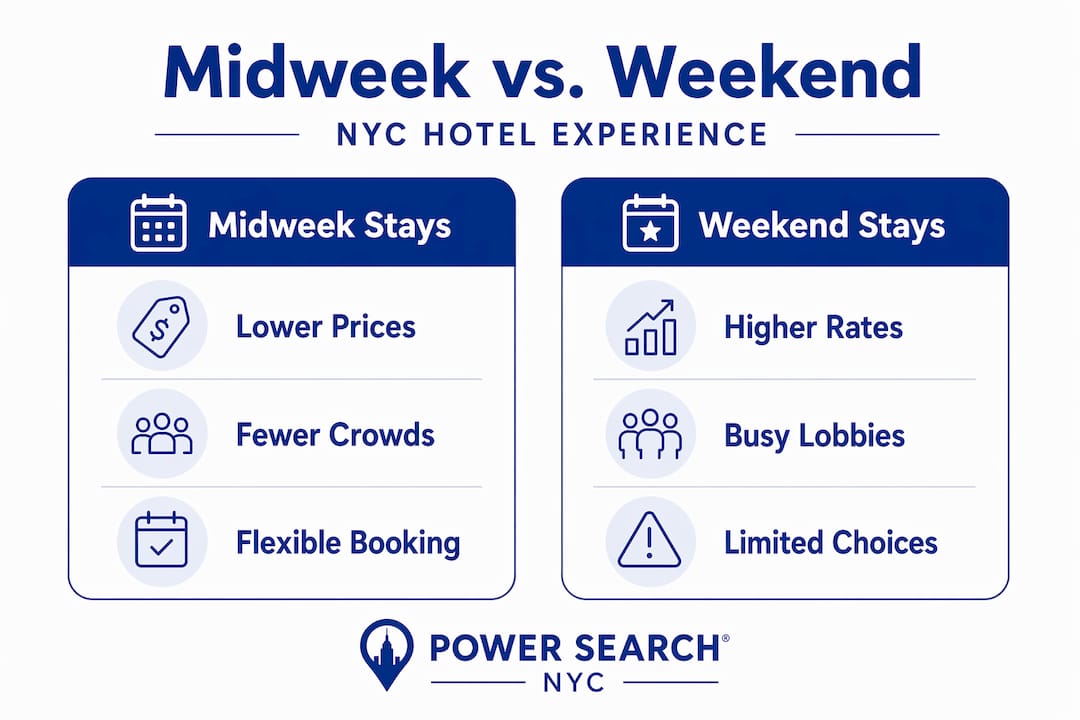
Still on the fence? Here is a direct comparison that puts the advantages of booking NYC hotels on a weekday into clear focus.
NYC midweek stays avoid weekend peaks where rates spike 25 to 35%, with January’s low season offering top hotels at roughly half the weekend price, around $200 to $300 versus $400 or more on weekends.
| Factor | Midweek (Mon to Thu) | Weekend (Fri to Sun) |
|---|---|---|
| Average hotel rate | $200 to $320 (3-star) | $300 to $450 (3-star) |
| Hotel occupancy | 60 to 75% | 85 to 95% |
| Room availability | Higher | Lower |
| Service quality | More attentive | Stretched thin |
| Attraction crowds | Manageable | Peak congestion |
| Restaurant access | Easy walk-ins | Long waits or no availability |
| Overall vibe | Relaxed, local feel | Chaotic, tourist-heavy |
Key takeaways from this comparison:
- Price advantage: Midweek rates are consistently 25 to 35% lower, and sometimes more during January through March
- Availability: More room types and upgrades are available when occupancy is lower
- Experience: The city is genuinely more enjoyable when it is not at full tourist capacity
- Service: Hotels running at lower occupancy deliver a noticeably better guest experience
Pro Tip: Check NYC hotel pricing insights to understand how resort fees and hidden charges affect your total cost. A lower nightly rate can still end up expensive if you are not watching the full picture.
Planning your midweek NYC trip: Practical tips to maximize value and experience
Now that you know the why and the how, here is how to put it all together into a trip that delivers real value without sacrificing the experience.
Checking NYC event calendars before booking is essential. High-demand events inflate prices 20 to 40% even on weekdays, so knowing what is happening during your visit can mean the difference between a deal and a disappointment. The UN General Assembly in September, major fashion weeks, and large conventions at the Javits Center all push midweek rates up significantly.
Summer midweek stays in NYC business districts like Midtown East soften further in July and August due to reduced leisure demand from heat and humidity, and extending your stay to three or more nights can unlock 15 to 20% package discounts. That is a meaningful saving on top of the midweek rate you are already getting.
Practical tips for your midweek NYC trip:
- Check the event calendar first. NYC hosts hundreds of events year-round. Even a midweek date can spike if a major conference or festival is in town.
- Extend your stay when possible. Three nights or more often qualifies for package deals with breakfast, parking, or attraction tickets included.
- Consider the outer boroughs. Brooklyn, Queens, and Jersey City across the Hudson offer lower base rates and great transit connections to Manhattan.
- Combine low season with midweek timing. January through March midweek stays offer the best overall value in NYC. You get both seasonal and weekday discounts stacked together.
- Pick the right neighborhood. Midtown East, Murray Hill, and the Financial District tend to have better midweek value than tourist-heavy Times Square.
Pro Tip: Read up on choosing the right NYC neighborhood before you book. Where you stay shapes your entire trip, and some neighborhoods are dramatically better value midweek than others.
Why booking NYC hotels midweek is a traveler’s secret weapon
Here is the honest truth: most people never figure this out. They book their NYC trip for the weekend because that is when they have time off, and they end up paying top dollar for a more crowded, more stressful version of the city. The travelers who know better quietly enjoy the same hotels, the same restaurants, and the same skyline for significantly less money.
Travel expert Samantha Brown puts it plainly: midweek NYC bookings drop as hotels lower prices by Friday to fill rooms, saving travelers 20 to 30% on stays. That is not a fringe benefit. That is a predictable, repeatable pattern you can count on.
What makes midweek bookings especially powerful is that they create a compounding effect. You save on the room. You get better service because the hotel is less slammed. You spend less time waiting in lines at attractions. You get into restaurants you could not touch on a Saturday. The whole trip runs smoother, and you come home feeling like you actually got to experience New York rather than just survive it.
The travelers who treat midweek bookings as a strategy rather than a compromise are the ones who end up in luxury hotel deals NYC at mid-range prices. A four-star hotel at a three-star rate is not a fantasy. It is what happens when you book Tuesday night instead of Friday night.
If you have flexible work arrangements, remote work options, or just the ability to take a few days off during the week, midweek NYC travel is genuinely one of the best travel hacks available. It is not about sacrificing the experience. It is about getting a better one for less.
Discover exceptional midweek hotel deals with PowerSearch NYC
Ready to put these midweek strategies into action? PowerSearch NYC makes it easy to find the right hotel at the right price, whether you are chasing luxury deals on a three-star budget or hunting for the best value in a specific neighborhood.

Browse all available NYC hotel booking options with filters for price, neighborhood, amenities, and cancellation policy so you can book with confidence and flexibility. Not sure where to stay? The guide to choosing the right neighborhood helps you match your travel style to the right part of the city. PowerSearch NYC is built for travelers who want real information, real options, and real savings, not just a list of hotels with no context.
Frequently asked questions
Why are NYC hotel rates lower midweek compared to weekends?
Midweek hotel rates drop because leisure travel demand falls significantly from Monday through Thursday, prompting hotels to lower prices to fill rooms. NYC midweek rates average 30 to 50% below peak weekend prices, especially during the January to March low season.
Is it better to book NYC hotels early or last minute for midweek stays?
Both approaches have merit depending on your flexibility. Booking 6 to 8 weeks ahead secures availability, while monitoring rates within 48 to 72-hour cancellation windows lets you rebook at lower prices if rates drop closer to your stay.
Do midweek stays improve the overall NYC travel experience?
Absolutely. Midweek visits avoid the 85% or higher occupancy spikes that hit Midtown on weekends, which means better hotel service, quieter attractions, and far easier access to popular restaurants.
How can travelers find the best midweek hotel deals in NYC?
Start by checking the NYC event calendar to avoid price spikes from conferences or festivals. Extending stays to three or more nights can unlock package discounts of 15 to 20%, and combining midweek timing with the January to March low season delivers the deepest savings available.
Recommended
No Comments