

Why NYC Hotel Early Arrival Matters for Business
Disclosure: This post may contain affiliate links. We may earn a commission for purchases made through links in this post, at no cost to you.
You land at JFK at 7 a.m., you have a client presentation at noon, and your hotel room won’t be ready until 3 p.m. That is not a minor inconvenience. That is a productivity disaster. Understanding why NYC hotel early arrival matters for business travelers goes well beyond comfort. It directly shapes how sharp, prepared, and in control you appear from the moment your first meeting starts. This article breaks down hotel check-in policies, the real benefits of getting into your room early, and the strategies that actually work in a city where time is the scarcest resource you have.
Table of Contents
- Key Takeaways
- Why NYC hotel early arrival matters for business
- How NYC hotel check-in policies actually work
- Real benefits of getting into your room early
- Strategies that actually improve your odds
- NYC hotel types and early check-in policies
- My take on early arrival as a business tool
- Find NYC hotels that work around your schedule
- FAQ
Key Takeaways
| Point | Details |
|---|---|
| Early check-in is rarely guaranteed | Standard NYC check-in runs 3–4 p.m., so proactive planning is the only way to secure early room access. |
| Business productivity depends on early access | Getting into your room early lets you rest, prep, and show up to meetings focused rather than flustered. |
| Book the night before for certainty | Booking the prior night is the one method that guarantees early room access, though it adds cost. |
| Hotel type changes your odds | Business and airport hotels offer better early check-in flexibility than budget or luxury properties. |
| Direct booking and communication win | Calling ahead, using loyalty perks, and being clear about your needs consistently improves your chances. |
Why NYC hotel early arrival matters for business
NYC hotel check-in is officially known as “guaranteed arrival time” in hotel operations, and most properties set that time between 3:00 p.m. and 4:00 p.m. The reason is simple: housekeeping needs time to turn over rooms after the previous guest’s checkout, which typically happens by noon. Arrivals before 10:00 a.m. face the highest rejection rate because cleaning cycles have barely started.
For business travelers, this creates a real operational gap. You might fly in overnight from Los Angeles, land at 6 a.m., and need to be sharp for a 10 a.m. strategy session in Midtown. The hotel lobby is not your office, and a café bathroom is not where you want to refresh before meeting a C-suite client.
NYC specifically makes this worse because the city runs on a compressed schedule. Traffic from the airport alone can consume an hour. Add luggage storage lines, lobby waits, and the general chaos of a busy Manhattan hotel, and you have lost most of your productive morning before the day even begins. That is why understanding hotel arrival timing is not optional for serious business travelers. It is part of trip planning.
How NYC hotel check-in policies actually work
Before you can work around the system, you need to understand it. Here is what you are dealing with at most NYC hotels:
- Standard check-in window: Most hotels set check-in at 3:00 p.m. to 4:00 p.m., with checkout around 11:00 a.m. to noon. That leaves a tight housekeeping window.
- Early arrival fees: Fees range from about $20 to $120 depending on the property. The Marriott New York Marquis charges $99 for guaranteed 11 a.m. check-in. Yotel Manhattan charges $120 for access between 6 a.m. and 11 a.m.
- Occupancy impacts availability: High occupancy nights mean fewer rooms are cleaned and flipped early. Peak business travel periods, particularly Tuesday through Thursday, reduce your odds significantly.
- Loyalty status helps but does not guarantee access: Programs like Wyndham Rewards offer limited early check-in benefits subject to availability, not as a hard perk.
- Third-party bookings lose priority: When you book through an online travel agency, the hotel has less incentive to accommodate special requests. Direct booking gives front desk staff more flexibility and motivation to help.
One often-overlooked opportunity: pre-arrival hotel emails from the property sometimes include discounted early check-in add-ons. Most travelers delete these as promotional messages, but General Manager Matt Dalrymple notes they are a reliable and affordable way to lock in early access before you even arrive.
Pro Tip: Call the hotel directly 24 to 48 hours before arrival and ask to speak with the front desk, not reservations. Explain your business schedule clearly and politely. Front desk agents have far more discretion than automated systems.

Real benefits of getting into your room early
Think about what you actually need to do in the first two hours of a business day in NYC. Here is how early room access changes each of those moments:
-
Rest after overnight travel. Even 90 minutes of sleep in a proper bed before a morning meeting makes a measurable difference in cognitive performance. A lobby chair does not replicate that.
-
Shower and prepare professionally. This sounds obvious, but it is the most commonly cited issue among business travelers who land early. Showing up to a meeting wrinkled and traveling from a redeye is an avoidable liability.
-
Set up a functional workspace. Your room has a desk, strong Wi-Fi, a charging station, and quiet. Common areas do not. If you need to run a virtual call, review contracts, or finalize a pitch deck, your room is the only real option.
-
Avoid the lobby productivity trap. Sitting in a hotel lobby with your luggage is not neutral. You are consuming mental energy managing your bags, watching the clock, and staying alert in a public space. That mental drain adds up before your meeting even starts.
-
Access hotel amenities on your schedule. Business-focused hotels that operate around the clock are far more likely to give early arrivals access to fitness centers, executive lounges, and restaurant service. Starting your day with a proper breakfast and a workout is genuinely better for performance than starting it in a cab queue.
The psychological impact deserves its own mention. When you walk into a meeting having already settled into your space, reviewed your materials, and eaten properly, you feel in control. That confidence is visible. NYC clients and colleagues notice the difference between someone who arrived organized and someone who is still playing catch-up.
Strategies that actually improve your odds
Getting early room access in NYC takes more than wishful thinking. These approaches consistently work:
- Contact the hotel 24 to 48 hours before arrival. Be specific about your arrival time and your reason. “I have a client meeting at 10 a.m. and need to prepare” lands better than a vague request. Clear, courteous communication genuinely improves success rates.
- Book the prior night as a guaranteed solution. Yes, it costs more. But booking an extra night is the only method that removes the uncertainty entirely, and for business travelers facing early morning schedules, the cost is often worth the clarity.
- Use hotel mobile apps. Real-time room readiness notifications via apps like Hilton Honors or Marriott Bonvoy allow you to check in the moment housekeeping finishes, sometimes well before 3 p.m. You can plan your morning around that rather than guessing.
- Check your corporate card benefits. Many premium business cards include early check-in perks through hotel partnerships. Check your Amex Platinum or Chase Sapphire Reserve benefits before assuming you have no leverage.
- Ask about luggage storage proactively. If early access genuinely is not available, secure luggage storage immediately upon arrival and identify a quiet hotel workspace or nearby coworking space for the gap hours. Some NYC hotels near Midtown offer day-use access to their business centers even before room availability.
Pro Tip: If you are using a loyalty program, check your status tier before booking. Gold and Platinum status holders almost always get first priority when housekeeping frees up early rooms, even without a formal guarantee.
NYC hotel types and early check-in policies
Not all hotels treat early arrivals the same way. Here is a practical comparison for business travelers choosing where to stay:
| Hotel category | Early check-in flexibility | Typical early fee | Best for business? |
|---|---|---|---|
| Business hotels (e.g., Marriott, Hilton) | High, especially with direct booking | $0 to $99 with status | Yes, best overall fit |
| Airport hotels (JFK, LGA adjacent) | High, built for early arrivals | Often $0 to $50 | Yes, ideal for quick trips |
| Luxury hotels (Four Seasons, etc.) | Moderate, may charge premium | $100 or more | Situational, depends on rate |
| Mid-range hotels | Low to moderate | $20 to $80 | Mixed, varies by property |
| Budget/hostel properties | Low, rarely accommodated | Usually not offered | No, not recommended |
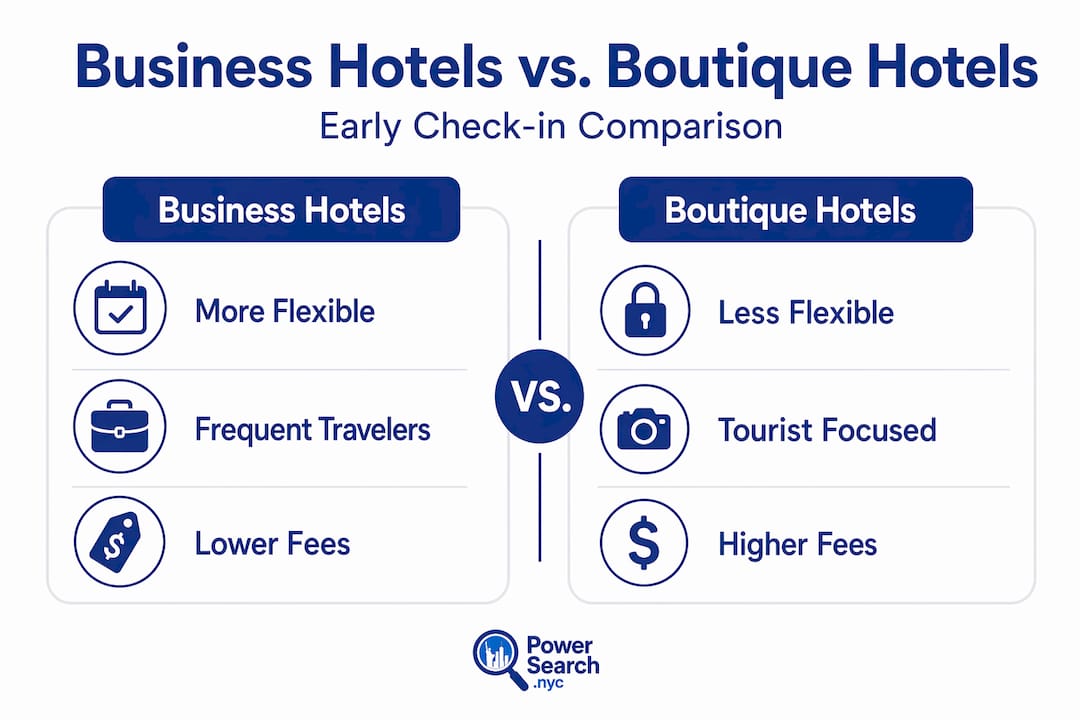
Business hotels and airport properties consistently offer the most flexibility because their core audience is road warriors with unpredictable schedules. Luxury properties may offer guaranteed early access but price it aggressively. The sweet spot for most business travelers is a well-reviewed business hotel in a practical neighborhood, booked directly, with loyalty status applied. You can find those neighborhoods and filter by business amenities using the best NYC neighborhoods guide on Powersearch.
My take on early arrival as a business tool
I have spent years watching business travelers treat early hotel check-in like a luxury upgrade. Something you request on a whim and shrug off when denied. That framing is completely wrong.
In my experience, the business travelers who consistently perform well in NYC treat early room access the same way they treat a confirmed meeting room or a reliable Wi-Fi connection. It is an operational requirement, not a preference. I have seen smart, experienced professionals show up to pitch meetings distracted and underprepared simply because they spent their morning camped in a lobby instead of their room.
The math is also cleaner than most people realize. Booking the previous night at a mid-range NYC hotel might cost you an extra $180 to $250. A botched morning that torpedoes a client relationship costs far more. When the stakes justify it, that extra night is not an expense. It is insurance.
What I have learned about working with hotel staff is worth remembering too. Being proactive and genuinely polite outperforms status alone more often than you would think. A calm, specific request made the day before arrival will get you further than flashing a loyalty card at the front desk on arrival morning. The staff has real discretion, and they use it for people who treat them well.
Early arrival in NYC is a competitive edge. Not everyone uses it that way, which means if you do, you are already ahead.
— Mark
Find NYC hotels that work around your schedule
Planning a business trip to NYC means accounting for every hour, including the ones before standard check-in. Powersearch makes it easier to identify hotels that actually fit a business traveler’s schedule, not just a leisure traveler’s.
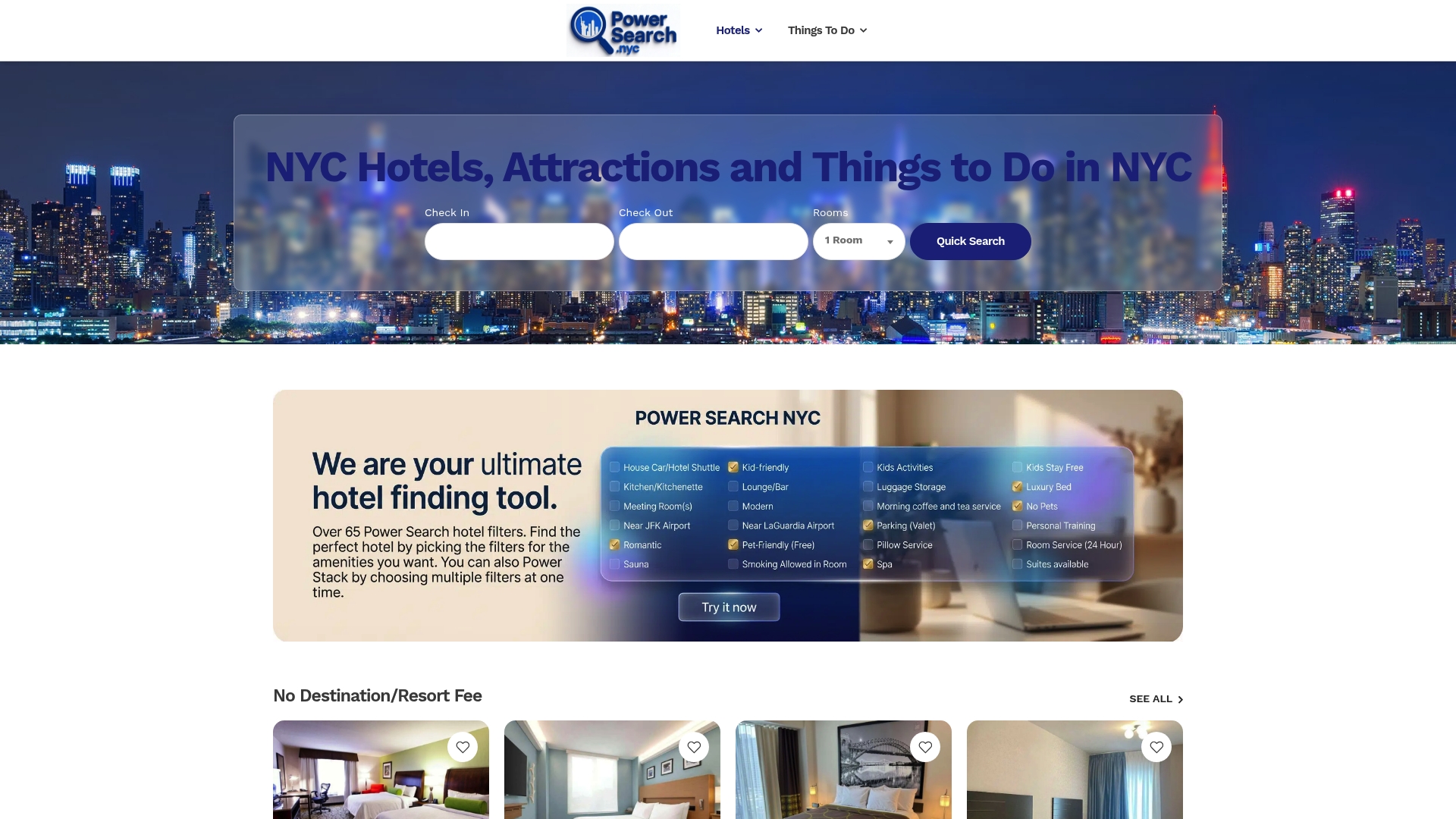
You can browse luxury hotel deals in NYC that often come with flexible direct booking options and better early access policies at prices that do not blow the travel budget. Powersearch also has curated resources like early check-in tips specifically for NYC arrivals, so you are not starting from scratch every trip. Whether you are booking for one night or a full work week, filtering by business amenities and neighborhood gives you a real head start on getting your stay right from the moment you land.
FAQ
What time do NYC hotels usually allow check-in?
Most NYC hotels set check-in at 3:00 p.m. to 4:00 p.m. due to housekeeping schedules. Arrivals before 10:00 a.m. are rarely accommodated without a fee or prior arrangement.
How can I guarantee early check-in at a NYC hotel?
Booking the night before arrival is the only guaranteed method for early room access. Alternatives like loyalty status and advance phone requests improve your odds but are not foolproof.
Is early check-in worth paying for as a business traveler?
Yes, in most cases. If you have morning meetings or an overnight flight, paying $50 to $100 for early access protects your productivity and professional appearance far more than the fee costs.
Do loyalty programs guarantee early hotel check-in in NYC?
Not automatically. Programs like Wyndham Rewards offer early check-in as a benefit subject to availability. Higher status tiers improve priority but do not eliminate the risk of denial during peak occupancy periods.
What should I do if my NYC hotel room is not ready on arrival?
Request luggage storage immediately, identify the hotel’s business center or a quiet lounge area, and ask the front desk to text you the moment your room is ready. Use hotel mobile apps where available to monitor real-time room status.
No Comments