

Why Outer Borough Hotels Cost Less in NYC
Disclosure: This post may contain affiliate links. We may earn a commission for purchases made through links in this post, at no cost to you.
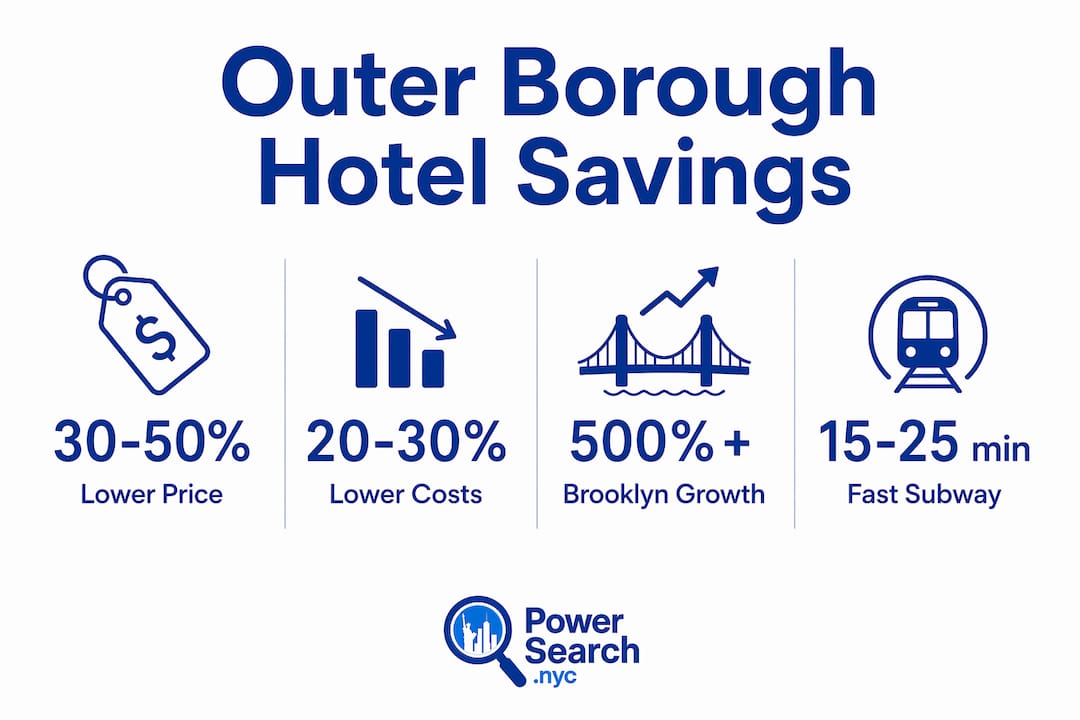
Outer borough hotels in New York City cost 30–50% less per night than comparable Manhattan properties, and the reasons go well beyond simple geography. Lower real estate costs, a dramatic surge in hotel supply, and location trade-offs all drive that price gap. Understanding why outer borough hotels cost less helps you decide whether those savings are real or partly eaten up by transit costs and commute fatigue. This guide breaks down the full picture so you can book with confidence, not guesswork.
Why do outer borough hotels cost less than Manhattan hotels?
The core reason is cost structure. Housing and lifestyle costs outside Manhattan run 20–30% lower, and hotels reflect that directly in their pricing. Lower land values mean lower mortgage and lease costs for hotel owners. Those savings pass through to the nightly rate you see on the booking page.
Supply also plays a major role. Manhattan hotel development is constrained by limited land, strict zoning, and sky-high construction costs. Outer boroughs have absorbed far more new inventory, which pushes prices down through basic competition. When there are more rooms chasing the same pool of travelers, rates drop.

Finally, amenity expectations differ. Many outer borough properties are economy or midscale hotels with fewer on-site restaurants, smaller lobbies, and leaner staffing. Those operational savings reduce overhead and keep nightly rates lower than full-service Manhattan hotels.
How hotel supply growth in outer boroughs drives prices down
The supply shift in NYC’s outer boroughs is one of the most dramatic stories in American hotel development. Room inventory tripled from 9,000 to 27,000 rooms, with Brooklyn supply alone growing over 500%. That kind of growth floods the market with options and forces hotels to compete aggressively on price.
More supply means travelers have real choices. When a dozen hotels sit within a few subway stops of each other in Brooklyn or Queens, none of them can hold rates artificially high. The result is a natural downward pressure on nightly prices that simply does not exist in Manhattan, where new hotel construction remains rare and demand stays consistently strong.
| Borough | Supply growth | Typical savings vs. Manhattan |
|---|---|---|
| Brooklyn | Over 500% increase | 30–45% lower nightly rate |
| Queens (Long Island City) | Significant growth | 40–50% lower nightly rate |
| The Bronx | Moderate growth | 25–35% lower nightly rate |
Pro Tip: Long Island City in Queens offers some of the shortest subway commutes to Midtown at just 15–25 minutes, with hotel prices 40–50% below Manhattan. It is one of the best-value locations in the entire city.
Understanding NYC room rate fluctuation helps you time your booking to capture even deeper savings on top of the borough discount.
What are the real commute trade-offs for outer borough stays?
Price is only part of the equation. Most outer borough hotels sit 20–45 minutes by subway from Midtown Manhattan. That commute adds up fast over a multi-day trip, and travelers often underestimate its true cost.
Here is what you need to factor in before booking:
- Daily subway fares. Each one-way ride costs $2.90. Two trips per day for five days adds $29 to your total bill.
- Late-night rideshares. After midnight, subway service slows and safety concerns push many travelers toward rideshares. A single Uber or Lyft from Midtown to Brooklyn or Queens can run $40–$80.
- Commuter fatigue. Spending 45 minutes each way on the subway after a full day of sightseeing drains energy. Commuter burnout is a real hidden cost that reduces the appeal of cheaper hotels farther from the action.
- Time value. If you are in NYC for three nights and spending 90 minutes a day commuting, you lose nearly half a day of actual vacation time.
Pro Tip: Brooklyn neighborhoods like Williamsburg offer full-service hotels with 20–35 minute subway commutes and strong local dining and nightlife scenes. Staying there feels less like a compromise and more like a deliberate lifestyle choice.
The outer borough stay makes the most sense when your itinerary includes attractions in that borough itself. If you are spending two days in Brooklyn visiting Prospect Park, DUMBO, or a restaurant like ASSAIA in the neighborhood, you are not commuting at all. You are already there.
How do total trip costs compare between boroughs and Manhattan?
The nightly rate is just the starting point. Outer borough savings of 30–50% translate to $500–$1,500 in savings over a five-night stay. But transit expenses can offset a meaningful chunk of that.
The right way to evaluate your options is to calculate total trip cost, not just the room rate. Add up your hotel bill, your daily subway fares, any late-night rideshares, and an honest estimate of the time you will spend commuting. Then compare that number to what a centrally located Manhattan hotel would cost for the same trip.
| Trip type | Outer borough total cost | Manhattan total cost | Real savings |
|---|---|---|---|
| 3-night short trip | Lower room rate, higher transit use | Higher room rate, minimal transit | Modest savings, often $150–$300 |
| 5-night longer stay | Lower room rate, transit costs spread out | Higher room rate | Strong savings, often $500–$1,000+ |
| Borough-focused itinerary | Lower room rate, near-zero transit cost | Higher room rate | Maximum savings |
Calculating total trip cost rather than just the base room rate is the single most important habit for accurate NYC budgeting. Travelers who skip this step often feel disappointed when their “cheap” hotel ends up costing nearly as much as a Manhattan option once rideshares and daily fares are counted.
The math clearly favors outer boroughs for longer trips and for travelers whose plans center on borough attractions. Short trips with heavy Midtown schedules narrow the gap considerably. Knowing when to book early can also sharpen your savings regardless of which borough you choose.
What market forces shape outer borough hotel pricing?
Beyond supply and real estate, some less obvious forces shape outer borough hotel prices. Outer borough economy hotels now compete with city contracts for emergency and migrant housing. That non-traditional use disrupts the normal hotel market by pulling rooms out of the traveler inventory and creating volatile availability.
This “comp set disruption” means some outer borough hotels price against emergency housing contracts rather than against other traveler-facing hotels. The result is unpredictable rates and inconsistent availability, especially in economy properties. You might find a great deal one week and see the same hotel fully booked the next, with no obvious seasonal reason.
The NYC hotel market has developed what analysts describe as a K-shaped performance split. Luxury Manhattan hotels thrive with strong demand and pricing power. Outer borough economy hotels face pressure from policy decisions, labor cost increases, and non-traditional competition. That split explains why you sometimes see outer borough hotels priced erratically rather than consistently below Manhattan.
Supply constraints and zoning laws have reinforced Manhattan’s pricing power by limiting new development there. Meanwhile, outer boroughs absorbed the bulk of new inventory, which keeps their rates competitive but also makes their market more volatile. For budget travelers, this means the outer boroughs offer genuine savings, but you benefit from booking early and checking cancellation policies carefully.
Key Takeaways
Outer borough hotels deliver real savings over Manhattan, but the full value depends on your trip length, itinerary focus, and willingness to factor in transit costs alongside the room rate.
| Point | Details |
|---|---|
| Core price gap | Outer borough hotels cost 30–50% less per night due to lower real estate and operating costs. |
| Supply drives competition | Room inventory tripled to 27,000 rooms in outer boroughs, pushing prices down through competition. |
| Transit costs matter | Add $2.90 subway fares and potential $40–$80 rideshares to your total before comparing rates. |
| Longer stays win | Savings of $500–$1,500 over five nights make outer boroughs most valuable for multi-day trips. |
| Market volatility is real | Emergency housing contracts and labor costs create unpredictable pricing in economy outer borough hotels. |
My honest take on outer borough hotels for budget travelers
I have spent a lot of time helping travelers think through NYC hotel decisions, and the outer borough question comes up constantly. My honest view: the savings are real, but they reward travelers who plan intentionally.
The mistake I see most often is treating the nightly rate as the whole story. A traveler books a $120 room in Astoria, spends $60 on rideshares over three nights because they stayed out late in Manhattan, and ends up paying $140 a night in real terms. That is not a bargain. That is a math problem dressed up as a deal.
Where outer boroughs genuinely shine is for travelers who stay four or more nights and build their itinerary around the borough itself. Brooklyn has world-class food, art, and waterfront views. Queens offers some of the most authentic local experiences in the entire city. If you are staying in Long Island City and spending two days exploring Flushing, Jackson Heights, and the Queens Museum, you are not sacrificing anything. You are getting a richer trip at a lower price.
The outer boroughs also give you something Manhattan cannot: the feeling of living in New York rather than just visiting it. You will see locals walking their dogs, grab coffee from a neighborhood spot, and feel the city’s actual rhythm. That is worth something beyond the dollar savings.
My recommendation is simple. Map out your itinerary first. Then calculate your total trip cost for both options. If the outer borough number comes out meaningfully lower and the commute fits your schedule, book it without hesitation.
— Mark
Plan your outer borough stay with Powersearch
Powersearch makes it easy to find affordable hotels in NYC across every borough, with filters for price, neighborhood, and amenities so you can compare options side by side.

Whether you are looking for a budget room in Long Island City or a family-friendly suite in Brooklyn, Powersearch curates listings that match your priorities and budget. The NYC hotel suite guide for families is a great starting point if you need more space without paying Manhattan prices. You can also browse the full NYC hotel and attractions search to build your itinerary around where you stay, not the other way around. Pair your hotel search with NYC travel discount cards to cut transit and attraction costs even further.
FAQ
Why are outer borough hotels so much cheaper than Manhattan?
Outer borough hotels benefit from lower real estate costs, higher room supply, and leaner operations. These factors combine to produce nightly rates 30–50% below comparable Manhattan properties.
Is staying in Brooklyn or Queens worth it for a short trip?
For trips of three nights or fewer with a Midtown-heavy itinerary, the savings narrow once transit costs are added. Longer stays or borough-focused itineraries deliver the strongest value.
How much can I realistically save by staying outside Manhattan?
Travelers save $500–$1,500 on a five-night stay by choosing outer borough hotels, though daily subway fares and occasional rideshares reduce that figure.
Which outer borough has the best subway access to Midtown?
Long Island City in Queens offers 15–25 minute subway rides to Midtown with hotel prices 40–50% below Manhattan, making it one of the most practical outer borough options.
Are outer borough hotel prices consistent year-round?
Not always. Emergency housing contracts and labor cost pressures create rate volatility in outer borough economy hotels. Booking early and checking cancellation policies protects you from unexpected price swings.
No Comments